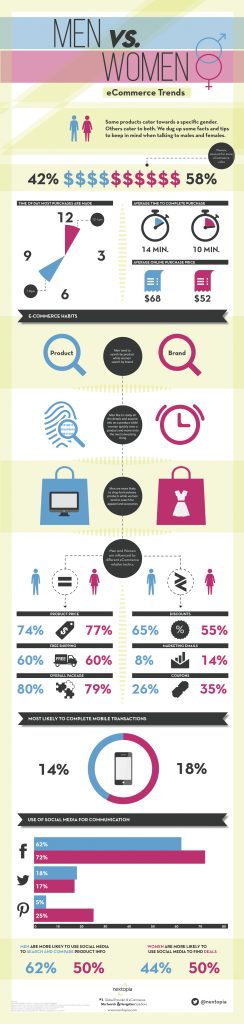
It’s been known throughout the centuries that men and women have different interests. However, merchants are still not putting that knowledge to use in their marketing strategies. In several studies, we have found that one huge mistake that many merchants are making is that they market products the same way to men and women. From shopping habits to the type of products, it’s important to keep in mind these gender differences to optimize sales. Check out the info graph below to learn more about the e-commerce battle of the sexes.
Please let us know in the comments below what you think!
Groupon and LivingSocial are pretty similar in what they do. They offer consumers flash deals in everything from eyelash extensions to iphone speakers. However, with so many deals that are flying around, how do you really know if you’re getting the most for your money? We have put together a very brief comparison between Groupon and LivingSocial so that merchants and shoppers can see what the difference really is.
Groupon Logo
Groupon
For Merchants: Groupon has a bigger audience than Livingsocial.
For Shoppers: Groupon offers the best deals in terms of discounts. Research has shown that groupon discounts are typically from 50-80% off, while livingsocial rarely offers discounts above 50%. Groupon also updates their website more often and offers more deals per day.
LivingSocial Logo
LivingSocial
For Merchants: Living social has better customer service. LivingSocial doesn’t just rush out a deal, they take into consideration trends and seasons to optimize each sale.
For Shoppers: Better quality? Some consumers argue that since Livingsocial offer less deals that they are more selective about their merchants. While only consumers can attest to this, it is a worthy point to consider.
Verdict:
While it seems that Livingsocial is currently a better space for merchants while Groupon is a better place for shoppers, perhaps both companies can take time to learn from each other.
Which one do you prefer? Groupon or Livingsocial? Let us know below.
In a recent study done by comScore, a sample size of 5,800 consumers were surveyed on their online shopping experiences. The following may surprise you but the stats offer insight on how to improve your e-commerce business.
Online Shopping
1. Call for mobile improvement! While studies have shown that mobile e commerce is on the rise, consumers feel that smartphones need to up their game. Online shoppers who shop on multiple devices prefer to use a desktop computer because of the larger and clearer images. Websites are also more clear and easier to navigate on desktops. When asked to compare a mobile site vs the full website, 41% of consumers preferred the full website.
2. Social Media matters. Social media is a way to connect to your consumers. It makes products easier to share and gives consumers an easy platform to review favorites. The largest platforms used by consumers today are Facebook (86%), Twitter (34%), google + (23%), Pinterest (21%), and Instagram (19%).
3. Omnichannel drives brand loyalty. Consumers expect and demand more cross-channel convenience. A retailer who optimizes every channel available to consumers are more likely to deliver a positive shopping experience which leads to more sales.
4. Delivery costs are a big factor in purchases. 58% of consumers have added more items into their shopping carts in order to qualify for free shipping. 83% will wait longer (average 2 days longer) for delivery if it’s free.
5. Step up your return policy game. 82% of consumers are more likely to buy an item if they are reassured that it is returnable (and with free return shipping).
If you have questions or comments, please leave a message below! We would love to hear from you.
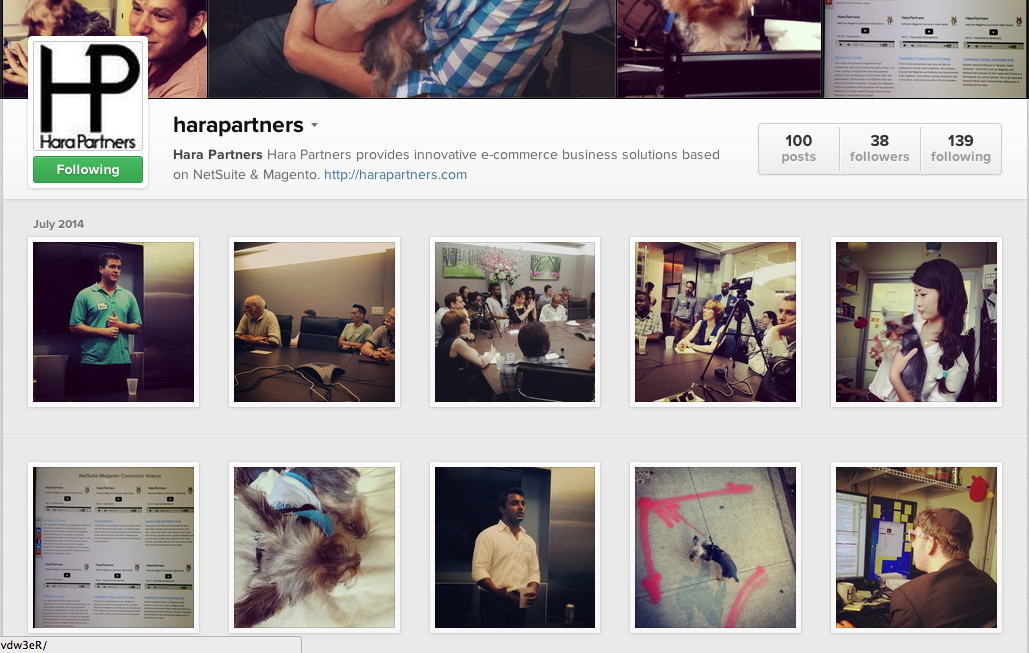
Instagram isn’t just a place for foodies and selfies anymore. More and more businesses are turning to Instagram as a place to showcase products, build brands and relationships, and ultimately increase sales.
Instagram is a unique platform that allows businesses to show their personality on stage and behind the scenes. Here are three reasons why Hara Partners loves Instagram!
1. Visuals. As more products and websites flood the internet, there simply isn’t a desire to read long paragraphs. The easy and fun layout is eye-catching and easy to browse. Instagram also doesn’t have a set algorithm to gauge what people see. Therefore, everything you post will be shown and it will stay in your gallery and archives.
On the merchant side, it is also easy to create and upload images, making visual marketing and branding fun and simple.
Hara Partners Instagram
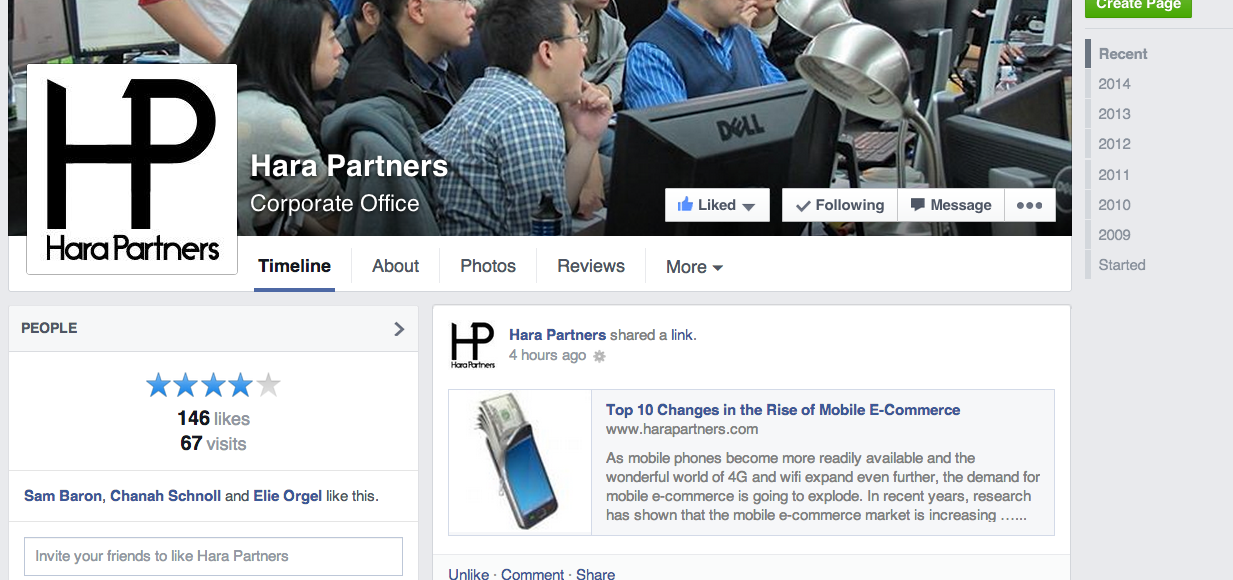
2. Facebook is reaching its decline. According to webmarketingtoday.com, a business’s content reach on Facebook has fallen 50%. A study done in March this year shows that the organic reach for brands on Facebook hover between 2 and 6%. This ongoing decline is driving away businesses and causing them to look for alternative ways to market their products via social media.
Hara Partners Facebook
3. Instagram is the largest growing social media platform. Recently, it has surpassed over 200 million monthly users, 20 billion photos shared over the course of its lifetime, and an average of 60 million photos shared daily.
As mobile phones become more readily available and the wonderful world of 4G and wifi expand even further, the demand for mobile e-commerce is going to explode. In recent years, research has shown that the mobile e-commerce market is increasing steadily and not projected to stop anytime soon.
In a sample size of more than 70 million consumers, 100 online retailers and $10 billion in transaction revenue…studies have shown that:
1. The mobile e-commerce market is now worth more than $40 billion.
That means that the value has doubled from 2012.
In 2010, it was only worth 2 billion and now, it’s projected to hit above $50 billion by the end of the year.
2. In the first quarter of this year, there were $12 billion in mobile e-commerce transactions.
For comparison, in 2010 only 3% of online store visits were from mobile devices.
3. 37% of all online store visits are from mobile devices.
4. While Apple dominated the mobile scene for a while, over the last two years iPhone shares have dropped from 75% to 54%.
Most of the difference went to Samsung devices, which now make up about 31% of sales.
5. Tablets are becoming the next big thing. Currently, tablets drive 25% of all sales.
6. This does not mean that desktops are becoming irrelevant! 76% of consumers are still purchasing from desktops.
7. 33% of purchases are direct purchases, while 27% of sales come from email marketing that direct to a web store.
8. Consumers are more likely to purchase from a website using a mobile device after successfully purchasing from a desktop.
9. More mobile purchases occur on the weekends!
10. The trend of mobile e-commerce is projected to increase universally for all goods.
If you have questions or comments about mobile e-commerce, please let us know below!
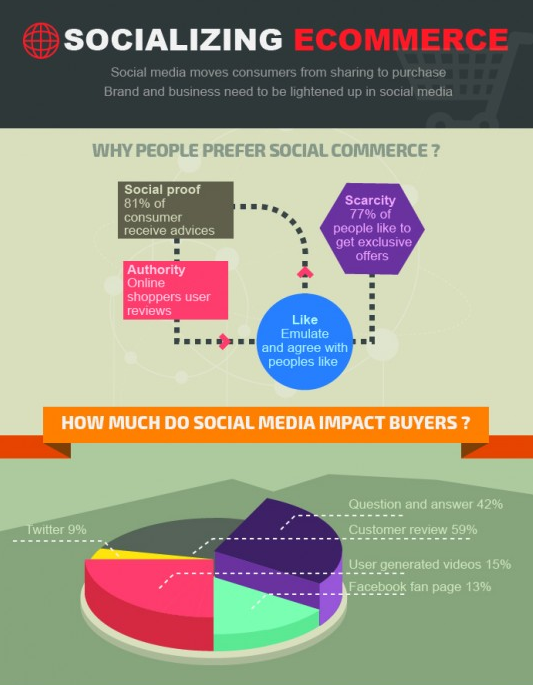
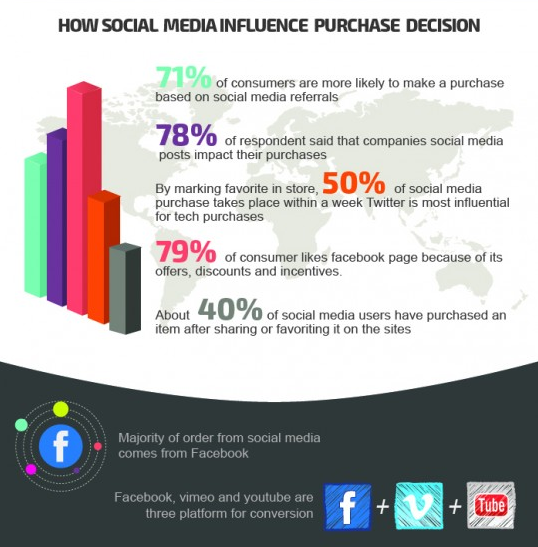
Social media has revolutionized the way that we communicate. But now, it’s revolutionizing the way that we shop. In recent studies by Unicommerce, social media has been proven to spread brand awareness and increase sales. The majority of order from social media is from Facebook. Other contenders include Vimeo and Youtube. From the data, user reviews, question & answer, and exclusive offers are the top reasons why people prefer social commerce.
71% of consumers are more likely to make a purchase based on social media referrals.
78% of consumers agreed that a company’s social media has affected their purchases.
40% of social media users have purchased an item after seeing it or favoriting it on a social media outlet.
Socializing E-Commerce
Influence of Social Media on Sales
From these results, we can conclude that brands and businesses need to step up their social media game in order to optimize their sales.
If you have questions or comments about the way that social media affects commerce, please leave a comment below.
One of the most important aspects of having an E-Commerce business is the prevention of fraud. E-Commerce Fraud prevention will make your business stronger, more reliable, and all in all better. Here are five tips from thehostingnews.com on what you could do today to optimize your fraud protection.
1. Address verification service (AVS) – This automatically starts verifying the address the customer provides to the address provided by the credit card issuing bank.
2. Fraud prevention software – This will detect malware driven transactions, phishing attacks, and other criminal activities. The key is prevention!
3. Require CVC2 and CVV2 verification – The 3-digit security code on the back of a credit or debit should be requested in addition to the expiration date. This extra security measure can eliminate fraud since it was less likely for a cyber criminal to have both the card number and the 3-digit code.
4. Note country of origin – Check the customer IP address! If your business is primarily based in the US and you see traffic that originates from other countries, this could be a sign of fraud.
5. Always verify – If you have any issues or suspicious, always contact the consumer.
Fraud prevention is not just about good technology, it also relies on good business practices. Make sure to educate your consumers about online security.
If you have any questions, comments, or additional tips on how to prevent fraud, please comment below!
The 2014 World Cup Finals are approaching, but have you considered a winning game plan for the world of ecommerce? Similar to all the top soccer teams (I’m looking at you Germany and Netherlands), all successful merchants need to focus on staying relevant in the field, putting together the best team, customer satisfaction, and going for the goal. The following infographic is from The eTailing Group’s 14th Annual merchant Survey. It provides insight into how future retailers plan to take home the trophy in their e-commerce initiatives.
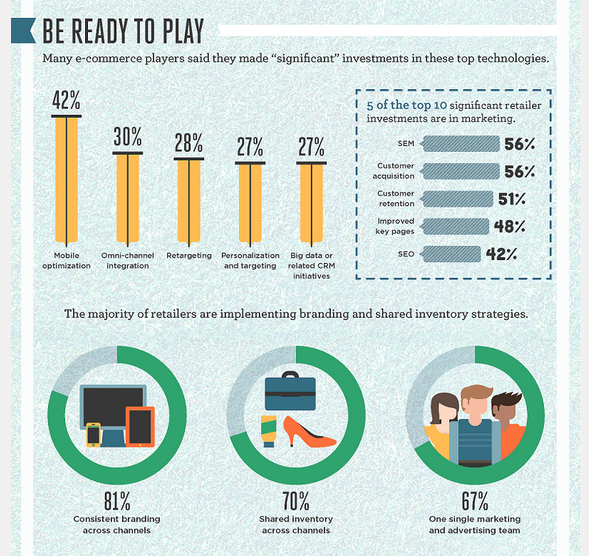
42% of Merchants made “significant” investments in Mobile Optimization
30% of merchants made “signiciant investments in omnichannel integration
The Top Strategies that deliver ROI are sales (98%), Email (94%), Promotions (93%) and Keyword Search (92%)
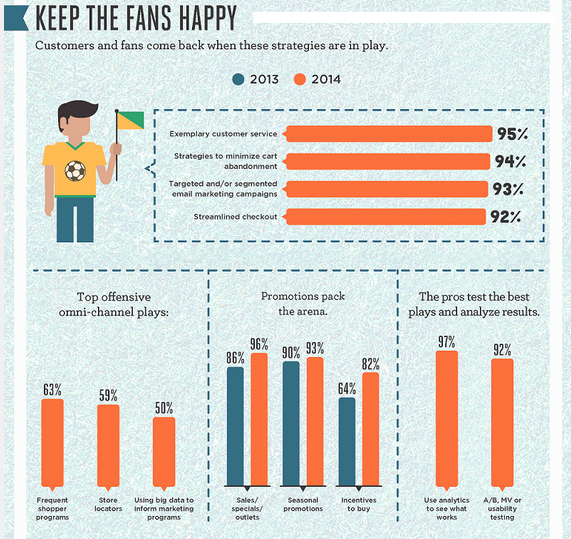
93% of Merchants have adapted strategies to combat cart abandonment
92% of Merchants have streamlined checkout
E-Commerce World Cup – Be Ready to Play
In 2014, merchants spent significant investments on improving their strategy to adapt to the changing market. The majority of merchants realized the significance of mobile optimization since in recent times, mobile devices have dominated the technological scene. Merchants also stress the importance of marketing, as 5 out of top 10 significant retailer investments are in marketing.
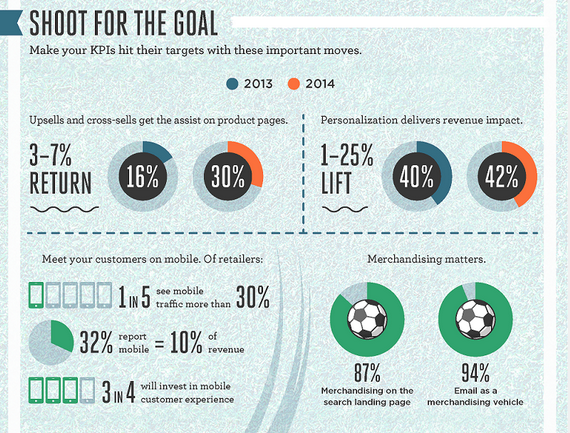
E-Commerce World Cup – Shoot for the Goal
98% of Merchants ranked sales/ specials/ outlets as the most valuable strategy in sales. Following closely behind are using email as a merchandising vehicle, seasonal promotions, and keyword onsite search. 79% of Merchants agree that “what’s new” is a power onsite tactic and 78% agree that “top sellers”, “top rated” and “visual searches” are also effective.
E-commerce World Cup – Keep the Fans Happy
As teams rely on fans for advancement, Merchants also need their customers. Since 2013, there has been significant improvement in the realization for promotions. 97% of Merchants also use analytics to test what works and what doesn’t. 95% of Merchants focus on exceptional customer service and there has also been an increase in improving minimizing cart abandonment and streamlining checkout.
E-Commerce World Cup – Shoot for the Goal
With all that’s said and done, keep in mind these four things that will help you score.
1. Upsales and cross sells get the assist on product pages
2. Personalization delivers.
3. Online mobile shopping is paving the way for the future.
4. Merchandising matters.
Questions? Comments? Who are you rooting for in the final game? Let us know.
Migrate from Magento Go to Magento Community with Openxcell
With the recent declaration made by eBay enterprise of shutting down Magento Go on February 1, 2015, online enterprises that are currently running on Magento Go will have to consider transferring to another hosted services.
Openxcell is offering to quickly re-launch the online enterprises through a smooth transition of all the data to a Magento Community platform.
With regard to the reason behind this major decision of closing Magento Go, Magento marketing head Craig Peasley stated, “The company is making these cuts to focus on the two Magento ecommerce software products that are having success. Its Magento Enterprise and Community Edition offerings, which target bigger and/or more sophisticated online sellers than Magento Go and ProStores did.”
“In this quest of choosing and changing over to a better platform, it is evident that potential online enterprises will be closely prioritising ease in transformation, and Openxcell is determined to offer a smooth going process for merchants who are planning to shift to Magento Community pertaining to better future prospects.” Says Jayneel Patel, the CEO of Openxcell Technolabs. He further stated,”By availing the shift to Magento Community through openxcell’s migration service, online merchants can expect high level of customization in designing and coding, which certainly did not fall in place with the Magento Go platform.”
Along with the benefits of custom magento development, there are numerous other aspects that will come in as added advantages. Magento Community is known for developing a large number of added extensions, both free and paid, which would allow the potential merchants to avail critical extensions for Payment and Shipping that would ease out the following functionalities. Online enterprises will be able to host without any limitations on the Magento Community platform, which in a way would best meet their expectations and requirements altogether. Merchants would also be able to acquire unlimited space in the server and bandwidth. Moreover, Magento EC will only demand a one time development cost, which would widely simplify the hosting process.
The Kroger Co. and Vitacost.com, a leading online retailer of healthy living products, today announced a definitive merger agreement under which Kroger will purchase all outstanding shares of Vitacost.com for $8.00 per share in cash, or approximately $280 million. The terms of the agreement were approved unanimously by both companies.
The purchase price represents a premium of 51% to Vitacost.com’s closing share price on Feb. 19, 2014, the day before a major Vitacost.com shareholder publicly asked the company to evaluate strategic alternatives. The terms of the agreement were unanimously approved by the Boards of Directors of both companies. Kroger Chief Executive Rodney McMullen said the grocer plans to add some of its own natural and organic foods, sold under the Simple Truth brand, to Vitacost’s website, which currently offers more than 45,000 products to about 2.3 million active customers.
About Kroger: Kroger, one of the world’s largest retailers, employs more than 375,000 associates who serve customers in 2,640 supermarkets and multi-department stores in 34 states and the District of Columbia under two dozen local banner names including Kroger, City Market, Dillons, Food 4 Less, Fred Meyer, Fry’s, Harris Teeter, Jay C, King Soopers, QFC, Ralphs and Smith’s. The company also operates 786 convenience stores, 320 fine jewelry stores, 1,240 supermarket fuel centers and 38 food processing plants in the U.S. Recognized by Forbes as the most generous company in America, Kroger supports hunger relief, breast cancer awareness, the military and their families, and more than 30,000 schools and grassroots organizations. Kroger contributes food and funds equal to 200 million meals a year through more than 80 Feeding America food bank partners.
About Vitacost.com, Inc: Vitacost.com, Inc. is a leading online retailer of health and wellness products, including dietary supplements such as vitamins, minerals, herbs and other botanicals, amino acids and metabolites, as well as cosmetics, organic body and personal care products, pet products, sports nutrition and health foods. Vitacost.com, Inc. sells these products directly to consumers through its website, www.vitacost.com. Vitacost.com, Inc. strives to offer its customers the broadest selection of healthy living products, while providing superior customer service and timely and accurate delivery.