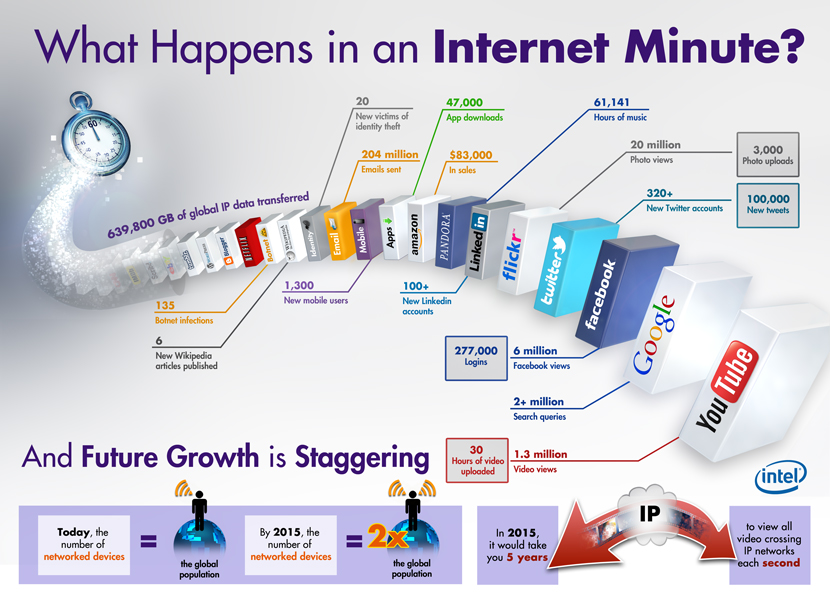
The folks at Intel decided to find out just how much data gets processed on the internet each minute, including eCommerce; their research led to the infographic displayed below.
Some of the highlights of what they discovered include:
In each internet minute:
A staggering 639,800 GB of IP data is transferred.
30 hours of video were uploaded to YouTube.
61,141 hours of music was streamed by Pandora.
20 Identities were stolen.
100,000 new tweets posted and 320+ new Twitter accounts were created.
The old adage claims that time is money, taken at face value this means it takes time to make money. But in the eCommerce world the opposite is true – if it takes your customers too long to make their way through your website they’ll just go somewhere else to spend.
2 seconds – optimal page load time as per 47% of consumers.
3 seconds of load time, after which 40% of consumers leave a page.
7% – conversion reduction when load time slowed by 1 second.
It doesn’t take more than a second of looking at these numbers to realize that your site had better run at peak performance if you expect to make any sales. This is especially true with Magento a platform famed for its complexity.
Magento Optimization
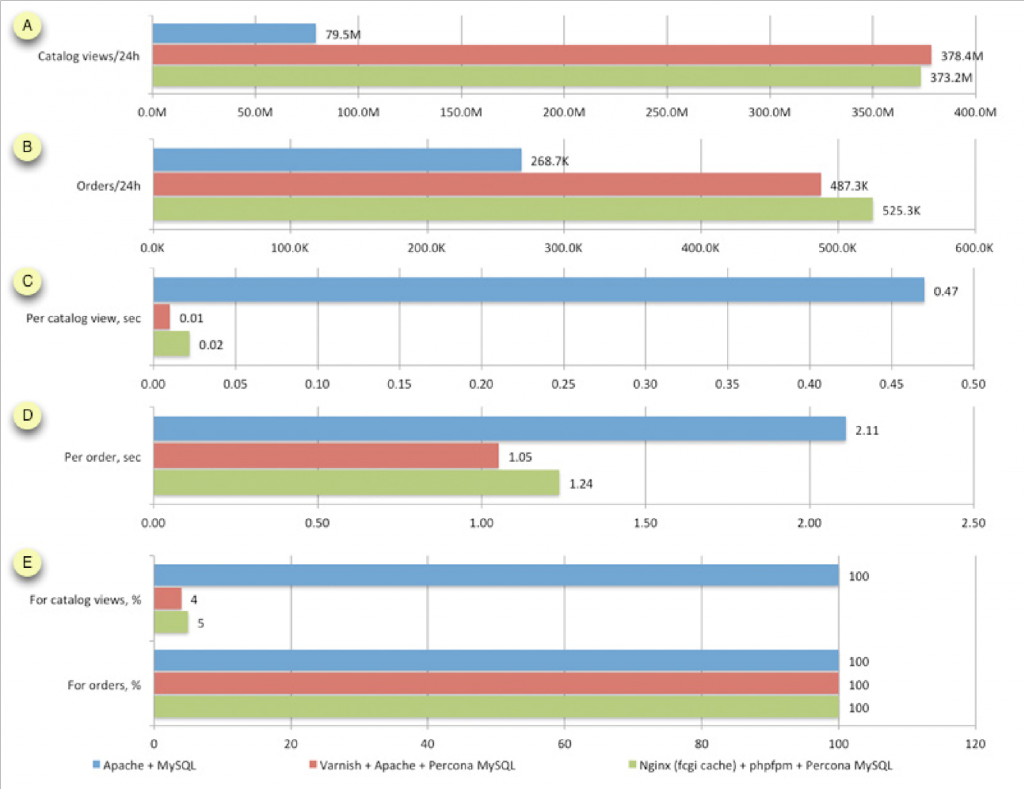
Optimizing Magento generally refers to availing oneself of a good caching set-up and some quality hardware, and of course having the right Magento partner to handle the operation is essential, as well. The folks at Magento set out to find out exactly how much of a difference a good cache set-up could make. For the control group in the experiment the Magneto optimization test team chose the most widely used set-up of Apache and MySQL. Once a baseline had been established the yMagento optimization team compared the results against two other set-ups, one in which the cache was optimized with Varnish and another using Nginx. The results were conclusive: use of an optimizing program boosted the performance of Magento by as much as 500% compared to the standard set-up. SThe full results table is shown below, some of the highlights include page load times lowered from .47 to 0.002 seconds and possible daily catalogue views were raised from 79.5 million without optimization to over 373 million with an optimized set-up.
Image credit: Magento
Don’t miss out on getting your piece of the e-pie – get your Magento optimization done by Hara Partners, contact us to find out how.
Now is the time to take the plunge into eCommerce. According to industry research online sales are expected to top $1 trillion in 2013 and experts predict that this number could increase by a whopping 44% by 2016. But when crafting your online presence which e
Commerce platform should you choose? The answer, of course, is Magento CMS.
What Makes Magento CMS Great?
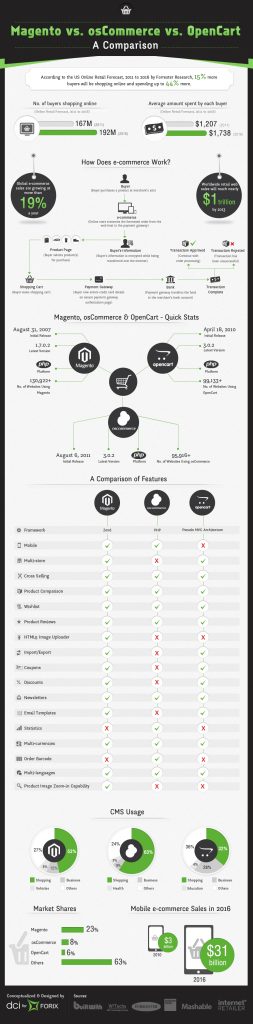
Take a look a this great infographic, cooked up by the folks at Forix, that shows exactly how Magento compares to some of its closest competitors and you’ll understand why Hara Partners chose the Magento CMS platform as its eCommerce solution of choice.
The Magento CMS Platform is the original and has the largest customer base.
Magento CMS stores are mobile ready – don’t miss out on this already massive and still growing market segment.
Magento CMS is far ahead of the others when it comes to product displays with HTML5 capabilities and built-in zoom features.
The only thing that could make Magento a better eCommerce solution is a robust and cloud-based ERP that integrates seamlessly. That’s why Hara Partners created the Magento NetSuite Connector. The connector allows necessary data to smoothly flow from one program to another, with no loss of efficiency. Created by the Magento experts at Hara Partners, our Magento NetSuite Connector features streamlined architecture, an intuitive user experience, and out-of-the-box functionality which make this the simplest Magento NetSuite integration and synchronization software available on the market.
Features of the Magento NetSuite Connector from Hara Partners
Improved Architecture The Magento NetSuite Connector from Hara Partners is built directly into the current NetSuite interface so the all familiar NetSuite tools remain. All relevant activity can be accessed as you prefer, in NetSuite or Magento, or both.
Improved User Experience
Real-time event-triggered reporting, driven by customer activity displays errors and metrics where and when they occur. As a result you’re more informed and better able to take action if it be required. By integrating your Magento front-end directly into NetSuite we can noticeably raise performance and improve responsiveness, bypassing difficulties that leave other Magento API based solutions foundering.
Developer-Friendly
To aid development and customization our developers maintained the core NetSuite and Magneto competencies by working within their native environments, so there’s no need to learn third-party technologies, or juggle multiple platforms. As one of the original Magento development companies we are intimately familiar with both platforms and our developers took pains not to impede or impair any core functionalities.
How Does It Work?
The NetSuite Magento Connector features a centralized dashboard so most tasks and reports can be accessed in one location, saving you significant time and effort. Included features:
Real-time monitoring automatically imports new orders into NetSuite at your your specified intervals. New orders are transferred with no information loss, all relevant product and customer data is passed along.
All product configurations and fields from both platforms remain to ensure no loss of functionality.
In general, the day to day activities associated with running a retail operation don’t leave e-tailers and their employees with much free time. Unfortunately, that means when something crops up that must be taken care of someone has to stop their normal responsibilities to take care of it. Often this task falls outside of the normal job description and area of expertise of the poor soul whose responsibility this has now become. The upshot is that fixing said issue takes far longer than it needs to, and during that time something that should be getting done is being neglected. And when your business is built upon a platform as intricate and complex as Magento is, a small issue can turn into a major disaster quite quickly. Large companies have teams of employees just for these such occasions but what are small- and midsize-business owners to do? The answer is Magento Managed Support Services from Hara Partners
Magento Managed Support Services – By Hara Partners
With Magento Managed Support from Hara Partners you’ll have a team Magento experts on your side. From prophylactic measures like site auditing with our proprietary HealthCheck software and quarterly strategic planning sessions, to a 24/7 helpdesk with phone support and uptime guarantees – worrying about the back-end of your company will be a thing of the past.
Magento Managed Support Services – what’s included?
Our Magento Managed Support Services packages cover three distinct arenas: Set-up/Optimization assistance, issue prevention, and strategic planning, and issue management.
Set-up/Optimization Services:
Hara Partners team of Magento experts will make sure that you are getting the absolute maximum from Magento. Starting with the internal – we’ll review your core architecture and configuration settings – through to your back-end – importing and exporting and getting your reporting set-up – to the external – with branding and design assistance and SEO services – we’ll get your store in tip-top shape.
Issue Prevention and Strategic Planning:
Once your store is up and running in peak condition we can assess your risk factors and start taking measures to mitigate or prevent any issues. We’ll monitor your site’s uptime and performance so any issues are addressed promptly as well as using our proprietary site–auditing software HealthCheck to unearth any underlying issues with your site’s code so they can be addressed before any harm is caused.
Issue Management:
Included with Hara Partners Magento Managed Support services is a 24/7/365 Help desk with phone, email and ticket support, so we are never out of reach. Additionally, we provide a daily report outlining any issues that have occurred or might occur so your always informed and part of the decision making process.
When you use Magento Managed Support Services from Hara Partners we’ll take care of your Magento store so you can take care of business. This list is just the tip of the iceberg, to see the full array of features and options please visit Magento Managed Support Services from Hara Partners.
Exciting news from Internet Retailer: despite grim sequester predictions and a general belt-tightening attitude, U.S. web sales have had quite the strong year in 2012, exceeding $225 billion and 15% year-over-year growth. In fact, this is the third year in a row of online sales growth topping 15%, as per the following figures from the U.S. Department of Commerce:
How does this compare with total retail sales? It leaves them in the dust with a mere 4.2% increase in 2012, excluding sales of automobiles and parts. The figures get even more dramatic when we look at just the fourth quarter with its holiday boost: web sales totaled $71.6 billion not adjust for seasonality, a 36.3% boost for Q3 2012. All told, that constitutes 13 consecutive quarters of year-over-year e-commerce growth above 12.9%. Now there’s cause for celebration!
Simply put, e-tail’s growing portion of total retail sales is here to stay. In 2012, it accounted for 5.2% of total retail spending; on a non-adjusted basis and excluding sales in categories not commonly bought online (cars, fuel, foodservice), that translates to a 7.6% share of total retail sales in 2012, up from 2011’s 6.8%.
This may seem like a bunch of sanctimonious number-crunching, but it does demonstrate the advancing rate of retailers’ investment in (and consumer comfort with) an online paradigm. Online retail has proven itself a sea change more profound than the vagaries of national economic climate or even popular trends. It’s a truly global phenomenon demanding customized, responsive vehicles from entrepreneurs in its midst. No longer can one’s online presence remain a token effort to “appease a demographic” or “get it over with”—we’ve entered the age of plugged-in grannies and e-wallets. The wave continues!
As I’ve mentioned to you before one of the most important things to take care of for your Magento eCommerce website is hiring a quality Magento Developer. The Magento platform is extremely complex and notoriously finicky and it will up to your developer to tame the system for you so you can capitalize on Magento’s famed flexibility and endless customization potential. Hara Partners, in New York, is an ideal Magento Development partner, boasting loads of expertise and experience, for companies of any size.
Why choose Hara Partners for your Magento Development?
Experience
Hara Partners has extensive experience with Magento – we’ve been working closely with them since Magento first hit the market in 2007. The Hara professionals first reverse-engineered the Magento software in early 2008 and ever since we’ve been creating, customizing and integrating for our 250+ satisfied customers.
Expertise
The Hara Partners staff consist of a core carefully cultivated experts from fields spanning the business and eCommerce development spectra, and their hand-picked teams. Having experts from across all of business permits us to take a more holistic approach to Magento development in which we examine your business across its entire face – from marketing and sales strategies, to design and development and all the way to market analysis and long term planning.
Partnership Approach
At Hara Partners we ascribe to the belief that without listening to the customer we’ll never be able to make them happy; and so we place a heavy emphasis on transparency and collaboration. In fact, you’ll play an integral role throughout the entire process, tasked with brainstorming, strategizing and decision making duties, as well as reviewing and okaying strategies, blueprints and mock-ups at carefully chosen checkpoints. And we’ll take pains to ensure our relationship doesn’t end when the project has been completed, instead we’ll be there to ease you through updates, help with new feature training and troubleshooting, and to handle any future development issues, whether they be business oriented or technical in nature.
Full Service
Hara Partners is a full-service, all-in-one, entirely in-house Magento Development machine. We’ve helped past clients with:
Search Engine Optimization (SEO)
Magento-Optimized Hosting
Content Delivery Network (CDN) Services
Creation, integration and customization of Magento extensions, add-ons and themes
Magento Support
Site Auditing with Health Check Scalability
3rd party integration specialists – we’ll make Magento work with anything.
Design
Content/Media (Audio, Video, and Text) Creation
UI/UX and Information Architecture Experts
Branding and Image Specialists
Strategic Planning and Market analysis
Best Practices
Hara Partners is ideally situated at the crossroads of business, technology and design so we are in the perfect position to advise our clients of what they need to do and how they must do it if they want to succeed. Our experienced project managers will advise you every step of the way providing the industry norms and best practices information you’ll need to make the most informed decisions you can. Don’t trust your future to just anyone – choose Hara Partners and get what you deserve.
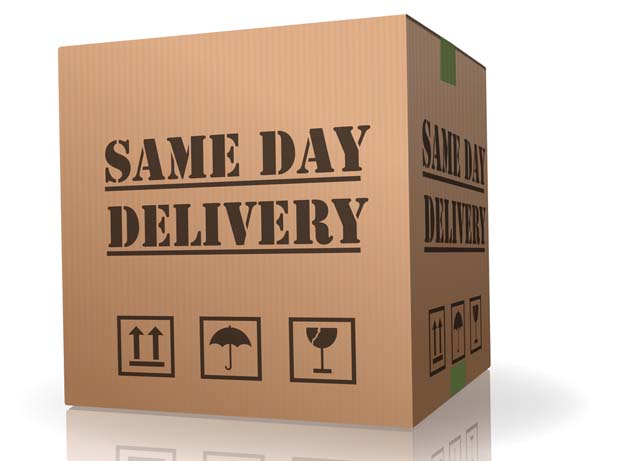
Welcome back! This article continues our exploration of a burgeoning online retail trend: same-day delivery. Is it worth it? How have companies fared? Read on for answers!
Broadened Spectrum
What about companies that already depend on same-day delivery for perishable or time-sensitive products—what do they stand to gain? 1-800-Flowers.com is using the USPS Metro Post service to expand delivery options for products besides flowers, including gourmet food brands. While it’s too early to gauge consumer reaction, the program is generating buzz and has already spread to other retailers in San Francisco in a region covering 26 ZIP codes.
To take full advantage of same-day delivery, it’s necessary to have a correspondingly robust infrastructure and communication system. Accurate, reliable data needs to be transmitted quickly to delivery companies in order to provide seamless service on the customer’s end. This is made much easier when companies already offer in-store pickup for online orders. Naturally, that trend is becoming common in the U.S. as well; with real-time inventory updates and intra-store merchandise allocation in place, transmission to outside delivery entities is made that much easier.
Complex Operations
The USPS Metro Post has the advantage of usage of its own trucks over courier-only services like Shutl and eBay Now, allowing it to accommodate web-only retailer like 1-800-Flowers with larger order volumes and extensive customer bases. They also use Postal Service software to calculate efficient routes for its four delivery vans in San Francisco. It can be tough to keep prices at or around standard ground shipping levels (~$10), but advertising certainly helps.
EBay Now’s model differs significantly: using a mobile app, customers locate the nearest available shopping assistant via built-in GPS, then tracks and communicates with the shopper if necessary to deliver a specific product on time. Shoppers can take advantage of eBay’s Milo system, offering mobile users real-time availability at nearby brick-and-mortar locations. They are also considering letting retailers set the price for promotions and other material usage. Again, it’s still too early to tell whether e-tailers will take to the service en masse.
Across the Pond
There are still some kinks to work out between Argos and Shutl, which have been involved since late 2010. Tests continue to evaluate pricing and discounts in the context of minimum order thresholds. They’re also weighing the benefits of free same-day delivery.
McCarthy is cautiously optimistic: “It is difficult to ascertain exactly the impact Shutl has had on customer conversion. The Shutl option is shown to the customer at the very end of their shopping journey and, theoretically, we have already converted the customer. However, from the repeat occurrences and the positive feedback we have received from users, it is both a fast and convenient way of getting goods to the customer, and offers yet another route that gives customers added choice and convenience.”
The cost of Shutl for retailers changes with the size of the order and the distance to the customer, but retailers can set their own price for their customers. They’ve been able to convert up to 45% of shoppers by keeping Shutl price at or below 5% of cart value.
Moving Ahead with Same-Day Delivery
As with most aspects of e-commerce, a balance must be found if same-day delivery hopes to take off. Covering e-tailers’ costs is important, of course, but everyone’s wary of repeating the mistakes of Urban Fetch and Kozmo.com. When they tried same-day delivery in the 1990s, they failed miserably because they overextended the service. Al Sambar of Kurt Salmon warns that same-day delivery has limited applications and absolutely isn’t right for every product, especially when the product itself can’t cover the cost of delivery. Convincing the customer with convenience and trustworthiness is the order of the day—only time will tell if online retailers rise to the occasion.
Paul Demery, Internet Retailer CTO, recently compiled some telling observations on the successes and challenges associated with same-day delivery for e-tailers. Below, a summary of his major points. This is Part I in a two-part series; be sure to check out Part II for the full story!
The latest trend in online retail seeks to appropriate a long-held brick-and-mortar advantage: receiving goods the same day you shop for them. Sure, there hasn’t exactly been an uptick in consumer demand for same-day delivery, but retailers are taking the usual “customers don’t know what they want yet” approach here; in tandem with delivery companies, they’re striving to shave overhead low enough to drum up interest. Some are even taking serious risks in an effort to jump the gun.
Spreading Fast
Case in point: UK retail chain Argos, a subsidiary of Home Retail Group, experimented with free same-day delivery for online orders just before last Christmas. The offer was made available to about half of its customers, spanning 50+ UK towns. Results were modest and costly, but ultimately deemed effective in terms of expanding the customer base. In the opinion of Brian McCarthy, Argos director of home delivery, “the whole market of competition is changing […] loyalty to brand is less; loyalty to price is stronger.”
Argos collaborates with London-based Shutl in the delivery process. Shutl dispatches online orders to local courier services, factoring availability, location, and performance record into the decision. With outposts in New York, San Francisco, and Chicago—along with planned operations in 17 more North American cities this year—the company is poised to ride the same-day delivery wave.
The landscape is populating rather quickly. USPS launched Metro Post last November in San Francisco, testing the waters with 1-800-Flowers.com Inc. and other retailers. Wal-Mart Stores Inc. debuted Walmart to Go in five metro areas, delivering online orders by truck. The trend gained speed with eBay Now, a mobile app being tested by major retailers in New York and San Francisco, designed to coordinate local courier pick-up and delivery services. And, of course, Amazon.com Inc. has had a successful same-day delivery service in multiple U.S. markets for a few years now.
A Wrench in the Gears
In an atmosphere of stiff competition, many retailers feel compelled to at least explore same-day delivery to remain viable amongst such strong growth. But it isn’t all sunshine and roses; according to experts, the jury’s still out on whether it actually wins customers or pads profits. Compared with one- or two-day delivery and/or in-store pickup—a safer option for retailers with fulfillment centers in major markets—same-day delivery demands a premium, which naturally gets passed on to the customer. These fees average $10 for most orders, which turns out to be enough to scare many customers away. Once that threshold is passed, they’d much rather opt to inconvenience themselves by picking the product up in person. When Moosejaw Mountaneering introduced same-day delivery in Chicago and Denver-Boulder for order placed up until 5 PM Christmas Eve, no one ended up using the $14.99 service. CEO Eoin Comerford speculates that a lack of heavy promotion and customer trust may have had something to do with the lackluster results.
Light at the End of the Tunnel
That hasn’t stopped dedicated entrepreneurs, though. Shutl’s investors include UPS Inc., European delivery service GeoPost, and venture capital firms e.ventures, Hummingbird Ventures, and Notion Capital. That’s $5M+ in investments since October put toward marketing in the U.S. and Canada—not too shabby.
And the service itself isn’t stagnant, either. Seeking to one-up Amazon, the next generation of same-day delivery providers is expanding the traditional window from 7 AM to noon to 2 PM and beyond. Walmart.com, by comparison, allows shoppers to choose a four-hour delivery window, even late at night.
Same-Day Delivery in Action
Here’s a sampling of typical same-day delivery services for online orders:
• Shutl: Scheduled to launch Q1 in NYC, Chicago, and SF. Delivery available 24/7, or when stores or warehouses are open. Fee set by retailers; Shutl recommends < 5% order value.
• USPS Metro Post: Customers in SF can order online until 2 PM, receiving deliveries 4-8 PM. Fee close to standard ground shipping, which for many orders is ≤$10.
• eBay Now: Consumers in NYC and SF test markets can have a personal shopper pick up the items ordered from a retailer’s store and have them delivered 9 AM-6 PM most days, with extended holiday hours. Fee=$5, with $25 minimum order.
• Walmart to Go: Customers in five major metro areas—Northern Virginia, Philadelphia, Minneapolis, San Jose/San Francisco, Denver—can order online until noon, then choose a 4-hour delivery window running to late in the evening. Fee=$10.
• Amazon Local Express Delivery: Order deadlines range from 7 AM-noon in 10 major cities—Baltimore, Boston, Chicago, Indianapolis, Las Vegas, New York, Philadelphia, Phoenix, Seattle, and Washington—for delivery up to 8 PM. Fee=$8.99 per order or $3.99 on eligible items for Amazon Prime members, a program that also offers two-day shipping for an annual fee of $79.
Creating a business and running it successfully is a complex, multifaceted task, and many entrepreneurs find themselves being tugged in every direction by the assault of responsibilities the influx of data and the weight of decision making to the point at which they lose sight of the forest because they are focused on all the trees. In many cases, in fact, businesses can be pulled under or swarmed over by competitors because the principals involved are too busy treading water to move forward with the eCommerce strategies that may save them. To help fledgling e-tailers the brain trust at Practical eCommerce has distilled the entrepreneurial experience down to 4 key metrics upon which every business must focus to ensure continued success, those metrics are:
1. Understanding the lifetime value of a customer;
2. Monitoring customer satisfaction;
3. Measuring your sales funnel;
4. Determining marketing ROI.
The Four Key Metrics of eCommerce Strategy
Understanding the lifetime value of a customer:
Experts suggest that instead of calculating ROI based on single sales store owners would be better served by focusing on the ROI over the life of a customer. This metric is significant because the cost of getting a new customer far outweighs those of retaining present customers. The formula recommended for this calculation is rather simple CLV = Present Value (Average profit per year x Number of years) – acquisition costs. Remember, be precise when calculating your average profits and acquisition costs or the value of the metric will quickly be diminished. Additionally, e-tailers may find value in adding some customer experience metric, like NPS, to accurately assess and predict customer retention. Once you’ve gained a deeper understanding into your customer satisfaction levels you be more able to interpret the CLV’s you’ve calculated.
Monitoring Customer Satisfaction:
There are many tools available to help you understand your customers – analytics software that tracks demographics and traffic statistics, for instance – but the best option may just be to actually talk to your customers. In fact, studies of failed businesses often revealed that those businesses left customer service as an afterthought in favor of more business oriented strategies, or simply had entire department outsourced. Once you’ve gotten a feel for who your customers are it is a good idea to implement some satisfaction metrics. Survey and feedback requests are a good starting point but eventually you’ll want something more robust, again NPS may be your best bet.
Measuring Your Sales Funnel:
Use readily available tools, the advanced segments on Google Analytics, for example, to measure the size of your sales funnel. Tracking assets like landing pages, conversion rates, and site traffic can tell you a lot about how successfully your marketing efforts have turned into actual sales. Once you’ve determined your successes and failures you’ll be able to make better decisions about which tactics to continue, which to ramp up, and which to abandon altogether. In addition, make use of tools like A/B testing to really dial into what makes you most successful.
Determine the Marketing ROI:
To determine the return on your marketing investment it is a good idea to chart your average acquisition cost; the formula to use is AAC = Acquisition spending/ number of customers acquired. Once you’ve generated a number that represents how much each customer has cost you simply compare that value with your calculated CLV and adjust your marketing spending until the numbers lie where you’d like them.
Opening a business IS hard, that’s why so many of them fail so rapidly. But by studying successful businesses and mastering the shortcuts and heuristics they employ anyone can run a successful e-business.
To find out more about how the experts at Hara Partners can assist you with eCommerce Strategy please contact us.