E-commerce, short for ‘electronic commerce,’ entails the trading in products or services using computer networks such as the Internet.
E-commerce draws on technologies such as mobile commerce, electronic funds transfer, supply chain management, Internet marketing, online transaction processing, electronic data interchange (EDI), inventory management systems, and automated data collection systems.
Below you’ll find a bunch of our posts related to e-commerce. Some of the topics that our company bloggers cover include magento e-commerce, and the best ecommerce sites that are currently active on the web. Because e-commerce is a wide and expansive field that is constantly growing, our team is constantly on the go to cover all the latest and greatest news associated with e-commerce.
Since Hara Partners is an e-commerce solutions company, all of the e-commerce going-ons in the world are of the most maximal concern to us. Some of the topics that we covered in the past include Asian e-commerce, mobile e-commerce platforms, and e-commerce trends.
For your information, we’ve also listed some of the common types of e-commerce platforms below:
On Premise E-commerce:
On-premise E-commerce software usually requires initial one time purchase investment in terms of licensing fees. Also, it implies extra costs related to hardware and installation services as well as data migration and on-going maintenance fees that are usually charged on a yearly basis for software updates and support. Some examples of typical on premise E-commerce platforms are Hybris, Sanna Commerce, Oorjit, and IBM WebSphere.
Software as a service (SaaS) E-commerce:
Software as a Service (SaaS)- is a cloud based delivery model in which applications are hosted and managed in a service provider’s datacenter, paid for on a subscription basis and accessed via a browser over an internet connection. Two examples of typical SaaS E-commerce solutions are Shopify and Demandware.
Open Source E-commerce:
Open source e-Commerce is a free of charge platform that doesn’t imply licenses fee. Furthermore, open source users are also responsible for installing, maintaining, securing and configuring the software on their own servers. In order to set up an open source platform, basic technical expertise is required in the areas of web design and development. Software products that are distributed as open source are generally free, and users can access and modify the source code. Three examples of typical open source E-commerce platforms are PrestaShop, osCommerce, Magento and Thelia.
With the calculation of sales taxes now requiring more accuracy than ever, ZIP codes are fast becoming a relic of the past. If one ZIP code can contain four different sales tax rates, how can anyone predict the correct sales tax rate without foregoing some critical information?
With so many jurisidctions generating rates, rules, and boundaries, sales tax complaince can be a nightmare for businesses. When businesses sell into new states, they must track even more rates, rules, and boundaries.
One fast way to eliminate human error regarding sales taxes is through our Magento Sales Tax and Use Tax module. Your tax lookups will be fully automated in the shopping cart and during the checkout process. The module also deliver SaaS-based tax rates, and allows drag-and-drop mapping by product, automatically correlating to a comprehensive list of nationwide product codes for every industry.
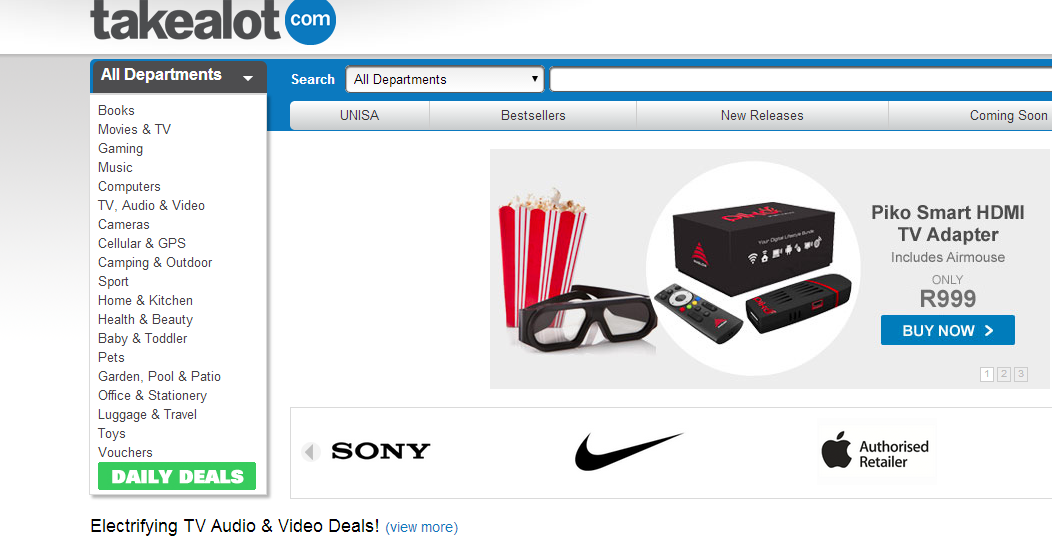
Takealot has recently announced that they are buying all of Superbalist.com, a curated fashion and lifestyle eCommerce platform targeting young millennial consumers.
“We are super excited about the acquisition,” Takealot CEO Kim Reid told the media in a press release last week. “The millennial generation is deemed to be the most powerful and relevant market on the planet and we have managed to acquire a business run by millennials, focused on millennials. They have a great team and we are going to have fun building the business together.”
Similarly, Superbalist.com, formerly known as Citymob back when it was founded by entrepreneur Luke Jedeikin in 2010, went through its own identity revamp late last year, having undergone extensive branding to move away from the flashmob site model and towards a curated marketplace for young consumers to buy street culture fashion, gadgets and decor.
Despite a 100% takeover of the site, Jedeikin told Moneyweb that Superbalist will continue to operate as an independent entity.
What is Takealot?
takealot.com was officially launched in June 2011 with the goal of being the largest, most customer centric online shopping destination in Africa.
The business has evolved rapidly since inception, expanding category selection from the traditional categories of entertainment to lifestyle categories like Home and Kitchen. Today takealot.com is one of the fastest growing, most innovative ecommerce retailers on the African continent.
Amazon’s branch in China has signed a memorandum of understanding (MOU) with Shanghai. The deal will pave the way for Amazon to bring millions of its e-commerce product offerings from around the world directly to Chinese customers.
Amazon has declined to comment on how much it will spend to set up business in the Shanghai FTZ.
In a statement emailed to the BBC, Doug Gurr, president for Amazon China said: “We seek to be the most customer-obsessed on-line shopping platform with vast selections, competitive price and most convenience in China. Today’s partnership announcement with FTZ and SII will help Amazon further realise our vision.”
Under the pact, Amazon will open its new cross-border e-commerce platform in the free trade zone. The online retailer will also establish a logistics and warehouse centre in the FTZ, whereby imported goods will enter China via the zone’s cross-border e-commerce platform.
Finding the right shipping partner is one of the biggest e-commerce challenges.
One of the biggest e-commerce challenges is finding a sensible middle ground for shipping charges. Charge too little and there’s no profit left, charge too much and your shoppers will go elsewhere. In fact, research has shown that shipping charges is the single largest cause of cart abandonment, with over 44% of buyers ditching because delivery fees were simply too costly.
Still, shipping is perhaps the most vital aspect of e-commerce as far as consumer perception is concerned. Evidence of this is that the paramount feature of the Google Trusted Stores designation is verified shipping estimates.
Read on for some insight into finding the right shipper for you.
Your Market:
Do you ship locally, regionally, nationally, or internationally? For local and regional shippers smaller, region-based shippers may be the best option, but if yours is a global operation, the smaller carriers clearly aren’t for you.
Your Products:
Many carriers are unable to ship “specialty” items. Some won’t ship very small packages, and some won’t ship overly large ones. Items requiring special care – electronic or medical equipment, food items, etc. – will also limit your options. Finally, if your products are consider offering insurance options
Tracking:
Providing tracking information to your customers is an absolute must. Whether shopping on Etsy or Amazon, consumers in today’s market take it for granted that tracking information will be provided, not fulfilling that expectation is one way to guarantee a customer won’t be back for a second purchase.
Average Order Size:
Regardless of how great the prices your shipper offers, if they can’t meet your demand they are useless. One thing to be wary of; shippers will usually charge different prices for different size packages, makes sure to read the contract carefully to ensure your biggest needs get the best prices.
Shipping Speed and Reliability:
An important question to ask a prospective shipping partner is how long it will take for your products to reach their destinations. Customer expectation is very high in this regard, and speedy shipping is a big factor in customer retention. A second question, perhaps of even greater import, is whether the shipper will meet his stated delivery dates. Slow shipping can be forgiven, missed delivery times never are.
Integration:
Does the shipper have an API that will work with your e-com platform? Robust integration will save you time when it comes to processing. And time, as everyone knows, equals money.
CBRE recently released a report titled E-Commerce and the Changing U.S. Industrial Landscape, in which they explain how increasing demand from the e-commerce sector for new, “big-box” facilities is reshaping the U.S. industrial market. The result of the increased demand is a strong leasing market for Class A space and build-to-suit developments, and has prompted the return of speculative construction.
E-commerce demands fuels Industrial Real Estate Market Boom
As per Scott Marshall, Executive Managing Director for Industrial Services, Americas, CBRE, “Demand from e-commerce companies has played a leading role in the recovery of the U.S. industrial real estate market over the past two years. During the first quarter of 2014, virtually all U.S. markets were buoyed by strong demand for distribution space from the e-commerce sector. Supply chain demand was centered in major inland and coastal port markets, resulting in strong absorption and shrinking availability in markets such as Atlanta, Chicago, Miami and Houston.”
Due to the limited availability of big-box facilities there is now a supply and demand imbalance in the industrial Class A market. In response, developers are signing build-to-suit deals at rates unheard of since prior to the recession, and building has already begun on approximately 45.7 million sq. ft. of speculative development. However, with estimates of current e-commerce requirements in the range of 30 million sq. ft. and the fact that e-commerce demand is still climbing it remains unlikely that supply will catch up to the demand anytime soon.
By 2017, online sales could be 10% of all retail sales
Head of Supply of Chain Services at CBRE Adam Mullen put it this way, “By 2017, online sales could account for more than one-tenth of all U.S. retail sales, up from 6.2% in 2013. To keep up with growing demand, e-commerce companies and, increasingly, traditional retailers are making major investments in big-box facilities that function both as warehouses to store goods and distribution centers to fulfill online orders.”
If you’re currently running a Magento based website, you should know that conversion rate is one of the most important factors for your site’s success.
The importance of the conversion rate lies in its ability to boost conversion rate of your website to increase the sales of your business. The following infographic from Magentodesignstudios.com contains some invaluable advice for eCommerce webmasters who are interested in increasing the success of their business.
The invention of 3-D Printing is expected to transform the world. When it becomes mainstream and available for all, it’s projected to cut down medical prosthetics to a fraction of the cost, challenge the make up industry, and make everything easier and cheaper to produce (like having a mini China hooked up to your laptop).
While 3-D printers aren’t available to the public quite yet, Amazon is still allowing consumers to reap the benefits. Amazon, an e-commerce dominating giant, just opened a new online store that allows consumers to create their own 3-D printed toy. Consumers are given a template of available objects and Amazon allows them to customize the color, design, and virtually anything else. So if you want an action figure or a bobble head with your face on it, check out Amazon’s new store! But be prepared to shell out anywhere from $40-$100.
A new version of Photo Gallery, Photo Gallery Pro Ver. 5.0, was recently announced in the marketplace, which allows for more opportunities to visualize products and show customers their best properties. Furthermore, powerful configuration options also allow merchants to organize the gallery easily and promptly.
Photo Gallery Pro is an add-on within Magento that allows merchants to create photo galleries, and customers to visualize the products offered within an e-store. The program allows you to read album descriptions, browse photo thumbnails, full-sized pictures or view a slide-show depending on the options that are selected.
Visitors can view additional images of any product in the store, as the module allows one to link photos to any product page. It’s a perfect solution for e-Commerce stores to increase customer response with an alternative content. Photo Gallery also offers SEO-friendly URLs and multistore support.
Have you considered what factors may be affecting your e-commerce business? Certain aspects influence whether or not a shopper will abandon their cart and successfully complete a transaction. Below is an infograph from MarketingProfs that will give you an in depth analysis of what works and what can be skipped.
Hashtags are becoming more prevalent in the social media marketing world. However, in case you haven’t been acquainted with it, we’re here to help.
Hashtags (#) are used on twitter, Instagram, vine, tumblr, facebook, and pinterest as a filter system. When you hashtag a picture or post with a certain word or phrase, it allows people searching for that specific word or phrase to find it easier. When it comes to e-commerce, hashtags can be used to optimize search results and to easily reach target audiences.
As the social media world expands, hashtags are also expected to expand across platforms. For example, if you post something with hastags on Twitter, it should be transferrable to Facebook with the same trends.
Although there are a lot of popular social hashtags going around, they’re not necessarily effective for e-commerce. Below are some tips to effectively hashtag for your e-commerce business.
1. Content. The content of a hashtag is very important. A hashtag (#) is followed by uppercase and lowercase letters or numbers. There cannot be any spaces or unique symbols (!@$%^&*()<>) because those character indicate the end of the hashtag.
2. Don’t Overuse Hashtags. Too much of a good thing can turn out to be a bad thing. It can turn off or confuse a reader to see a mass of hashtags. Generally, we recommend 3-5 hashtags max for twitter since there is a character limit, and 6-10 max for other platforms.
Correct: Check out the new Hara Partners blog! #ecommerce #harapartners #coolblogs
Incorrect: Check out the new Hara Partners blog! #ecommerce #harapartners #coolblogs #blogs #hara #partners #consulting #onlinesolutions #ilovehashtags #newblog #newpost #checkitout #haveyouseenthis #newblogpost
3. Choose the best hashtag. There might be a million hashtags that are relevant to your post but choose the best one. Think about what is most likely to be searched along with which hashtag would reach the best audience.
Correct: Check out the new Hara Partners blog! #ecommerce #harapartners
Incorrect: Check out the new Hara Partners blog! #shopping #onlineblog
4. Relevance. It might be tempting to hashtag your posts with the most popular hashtags so that it will reach a broader audience, however this is a bad idea because you could be labeled and punished for being a spammer.
Correct: Check out the new Hara Partners blog! #ecommerce #harapartners
Incorrect: Check out the new Hara Partners blog! #selfie #byefelicia #WCW
If you have any other questions about how to use hashtags, please comment below. We would love to hear from you. #contactus