“What was going through your mind when you bought that?” Now, thanks to this awesome infographic from the folks at moneysupermarket.com, you can finally answer the age-old question about how our brains influence our eCommerce spending habits:
eCommerce Spending Demystified
Which part of your brain were you using when you made the decision?
The mesial prefrontal cortex which makes decisions based on personal preference, before money comes into play.
The insular cortex where you feel actual pain relative to spending money, pushing you to make more financially responsible (read: cheaper) choices.
The nucleus accumbens, the gambler in our brain, which urges us to go ahead with decisions it feels will pay off in the end, ignoring the other parts of our brain and that feel less-than-confident.
What do casino chips, one-click-ordering, budget panning all have in common? They are all tricks designed to fool our insular cortexes by replacing actual cash, or even the very act of removing ones wallet from their pocket, with abstract tokens to reduce the pain related to spending.
Knowing how we are constantly manipulated can help you curb overspending.
Begin building your Magento store today with Hara Partners
In the wake of the Senate’s 69-27 vote in favor of the Marketplace Fairness Act of 2013, (the new internet sales tax law) and the impending vote in Congress, the outcome of which determines whether the bill becomes enacted into law, many e-tailers have found themselves in the unenviable position of uncertainty. They are unable to fully understand what the bill would mean for their business particularly and thus cannot take measures to prepare themselves. To assist e-tailers with this unwelcome and onerous task CCH, makers of the Sales Tax for Magento software suite, and one the of six CSP’s (certified software providers) approved by the bill, released a special report outlining what the bill actually would mean to online merchants; we’ll cover some of the highlights here.
Sales Tax for Magento Users: Demysitified
Proponents of the bill claim that their main motivation is leveling the playing field between brick and mortar merchants and their online counterparts who under current statutes have no requirement to charge sales tax. Additionally, states are looking to recoup their fair share of the $23 billion in tax revenue industry experts claim was “lost” in 2012.
Opponents claim that the bill fails to take into account exactly how difficult it would be for small businesses to maintain compliance in the myriad different jurisdictions whose laws they now find themselves subject to, and that adoption of the bill would leave merchant open to audits and other tax enforcement procedure in states where they have no legislative representation.
To begin collect sales tax from these “remote sales”, as the bill calls them, states would be required to meet certain criteria, among them:
Creation of a “single entity administration”, which means that the states must create:
A single entity responsible for all administration, processing and audit duties.
A single audit for all remote sellers.
A single sales and use tax return for all remote sellers.
And this entity has would have responsibility across all state and local jurisdictions
A “uniform tax base” for the purposes of simplifying compliance to possible levels.
Provision of software to handle all sales and use tax calculations and filing requirements.
While it is prudent for all e-tailers to begin planning how they will cope with these impending changes it is far from certain that the bill will pass through Congress at this time.
“Although the legislation received strong bipartisan support in the Senate, its future passage in the House isn’t a sure thing,” said CCH Principal Federal Tax Analyst, Mark Luscombe, JD, LLM, CPA. “Supporters claim the issue is about fairness and that Internet sellers shouldn’t enjoy an unfair advantage, but critics say it amounts to a tax increase.”
Hara Partners can get you started with SalesTax from CCH, find out more now.
Welcome back once more! This is the third article of three covering the challenges and concerns of e-tailers looking to expand operations into Asian e-commerce. Through a mix of mini case studies, relevant metrics, and solution strategies, we’ll explore the issue from the inside out. If you need to get caught up, please take a few minutes to read Part I and Part II before continuing. If not, let’s go!
Tech in Asian E-Commerce
Picking up where we left off, let’s take a look at how Zazzle was able to launch its international sites so quickly. Thanks to purpose-built data transfer and international-friendly modules, Zazzle was able to launch dual e-commerce sites in Australia and Japan with a few months of each other in 2010. For its Japanese site, Zazzle’s commitment to all-Japanese product descriptions and customer service, as well as yen-centric pricing structures, significantly eased the transition. Moreover, they collaborated with Transcosmos Inc. to arrange call center services and specialized marketing programs ahead of time, incorporating SEO and paid search utilities geared towards Japanese keywords and search habits. Their success is more or less directly attributable to these preliminary efforts.
Same goes for Newegg, the heroes of Part I in this series, whose use of internal technology and a substantial team of Chinese designers and programmers was pivotal in the launch of Newegg.com.cn. The eternal question for Western e-tailers looking to break in is one of differentiation: facing the inarguable success of native Asian e-commerce entities, how do outsiders distinguish themselves?
Newegg cobbled together an answer out of several important components. Their delivery network capitalized on regional carriers to extend the convenience of next-day shipping to several Chinese urban epicenters. They also ported in proven perks like live chat, longer warranties, and packaged installation services. Localization is the name of the game—they’ve become masters at representing it in the Newegg web experience.
Extending the Establishment
When it comes to established brands, sometimes existing momentum can do a lot of work. Take chain retailer Gap, whose national network of approximately 130 stores across its constituent brands in Japan has been in development since 1994. Thus, when they launched their Asian e-commerce site just last October, they had a successful operational infrastructure already in place. Customer favorites such as universal shopping carts and free local shipping were easily and efficiently integrated from day one. And many of their customer experience features translated well with Japanese customers, who loved Gap’s size charts, multi-angle photos, color switching, and zooming. They capped the experience off with return merchandise capabilities and dedicated Japanese content—all elements giving customers the “ability to shop how, when and where they want,” according to Gap Senior Director of Asia online Iris Yen.
The Final Word
Entering Asian e-commerce markets is largely a matter of bypassing expensive startup mistakes. There’s such diversity that U.S. retailers really need to focus on one or two to begin with. Experts put consumer involvement in emerging markets in terms of a four-stage evolution:
1. Once they have a device paired with a reliable internet connection, they start by exploring web content and using social media.
2. Then they take basic e-commerce steps: booking travel, etc.
3. Next they seek out entertainment: books, music, movies, etc.
4. Finally, having become fully integrated into the online shopping mentality, they purchase from the full spectrum of products: apparel, electronics, healthcare, even groceries.
Knowledge of your consumers’ place in this evolution is crucial and can truly mitigate the difficulties of the process. Circling back to Newegg, timing played a huge role in their astounding success when they entered the Chinese market. At the time, the foundation for e-commerce was in its infancy, and the Chinese government actively encouraged foreign investment with tax breaks. It was the right place and the right time for Newegg to step up and meet a growing demand. But perhaps most important of all was Newegg’s commitment to fostering regional relationships with existing Chinese businesses. Their continued success, and yours, is proportional to the recognition of and support for an emergent, consumer-driven market.
The Biggest Gainers in Asian E-Commerce Markets
Format: Retailer — 2012 Web Sales — 2011 Web Sales — Growth
NOTE: many of these figures are based on Internet Retailer estimates
AUSTRALIA
JB Hi-Fi — $52.9M — $29.9M – 77.2%
The Catch of the Day Group — $302M — $198M — 52.53%
CHINA
Suning Commerce Group Co. Ltd. — $4.76B — $945.1M —403.67%
Welcome back! This is the second article of three covering the challenges and concerns of e-tailers looking to expand operations into Asian e-commerce. Through a mix of mini case studies, relevant metrics, and solution strategies, we’ll explore the issue from the inside out. Check out Part I for an introduction to the topic. Let’s go!
Making Inroads in Asian E-Commerce
Iconic retailer Macy’s used its considerable resources to team up with FiftyOne Inc. and VIPStore, securing a delivery agreement with the former and a marketing deal with the latter to spearhead an initiative aimed at Chinese web shoppers (predicted to surpass 400M consumers by 2017, according to eMarketer Inc.). Even for a mammoth entity like Macy’s, understanding the habits and predilections of Asian online shoppers can be a struggle.
Just look at The Home Depot Inc., which announced in September imminent plans to close seven big-box stores in China due to China’s lackluster response to its stars-and-stripes DIY approach. In arena where success hinges on a sustainable e-commerce base, you’ve simply got to play to your audience better. And they will: instead of going it alone, they plan to cut the risk via a possible alliance with 360Buy Ltd., #3 on Internet Retailer’s list of the top ten Asian e-commerce retailers.
To the Amazon!
…or, more accurately, Amazon.com, who has Asian online market penetration down to a science. Their approach to Japan—notoriously tough customers ever since, well, the dawn of East-West trade—is practically textbook. Back in 2000, as one of the first U.S. retailers to enter the country, Amazon established a solid foundation by aggressively studying the buying and navigation habits among almost 193,000 Japanese customers already regularly using Amazon’s home site (again, there are benefits to extensive infrastructure and a robust market research team). From there, they built up a template for further action:
• Enter early
• Begin with a fully developed product inventory
• Utilize an intelligent and responsive customer service program
• Build site features around local shoppers’ preferences
Concurrently, they developed physical properties to facilitate large-scale logistics: a headquarters in Tokyo, regional distribution centers, and customer service centers. These efforts paid off in spades: from its amazon.com.jp property, an all-Japanese bookstore comprising 1.7M books by Japanese authors or popular translations, the company milked the region into its second-largest foreign market with $7.8B in 2012 sales, accounting for more than a quarter of Amazon’s 2012 international sales.
“Amazon likes to do its homework and make a big enough investment in all the right things to position itself to grow as the market grows,” quips Scot Wingo, ChannelAdvisor CEO. Indeed!
The Saga Continues
Of course, the battle is far from won. Amazon.com may seem to be sitting pretty with 11 Japanese distribution centers and 50M products on amazon.com.jp, but it still defers to Rakuten Inc., the market leader with 2012 estimated sales of $9.76B. Efforts continue to expand and revitalize Japanese operations. Like what? Try the Kindle Paperwhite and Fire tablets, recently released in Japan alongside a Kindle bookstore hawking Japanese digital content. There have also been strong initiatives to augment its fashion and food product offerings, as well as plans to fortify same-day delivery to more of western Japan.
“Amazon is setting the bar,” says Wingo, “[that] a lot of other U.S. and Japanese retailers will have to meet.” Yet they aren’t sitting idly by—they’re taking cues! Amazon took about 18 months to launch its first Asian e-commerce site, whereas Zazzle was able to up the ante since then via quicker data transfer between its systems and sites. According to CFO Jason Kang, Zazzle anticipated these challenges, incorporating codes and modules accommodating a variety of languages and currencies when it developed its internal e-commerce platform in 2005. All told, this cut the time to go-live for its Asian e-commerce site by half.
The Ten Fastest-Growing E-Retailers in Asia
Format: Retailer (Country) — Asia 500 Rank — 2012 Web Sales — 2011 Web Sales — Growth
NOTE: many of these figures are based on Internet Retailer estimates
Mark Brohan, Internet Retailer Research Director, published a comprehensive write-up of the goals and opportunities for e-tailers looking to break into the world’s largest e-commerce market—none other than our largest continent, Asia. Even a cursory glance at the figures yields a knockout $377B in 2012 online sales, over $151B more than U.S. figures in the same period. China alone estimated about $179B in 2012. But the situation is not without its roadblocks. Read on for our coverage of this great reservoir of potential, comprising a three-post series on our blog.
A Case Study
Perhaps the best place to start is with an example: Newegg, a U.S.-based web-only electronics retailer with which you’re probably already familiar, began its mission to break into China more than ten years ago. Way back in 2001, at the dawn of the online shopping craze, the company began planning the initiative—and as native Taiwanese with cultivated relationships in the Chinese business world, they weren’t exactly debutantes. It still took a year for Beijing to approve a certified web merchant license. And that was just the start!
Consider logistics: $25M to finance a headquarters building, regional fulfillment hubs, and a bespoke delivery network incorporating area carriers. Oh, is that it? How about this: next they had to file and win a slew of lawsuits to snag their desired domain name (Newegg.com.cn), followed by the mind-bogglingly complicated process of devising an effective Chinese-centric e-commerce strategy. It’s truly a different animal, and the only way to proceed in such an unfamiliar environment was by trial and error.
But it paid off! Now #28 in Internet Retailer’s 2013 Asia 500, Newegg scored Chinese web sales around $400M in 2012, with business growth topping 50% year-over-year. Big investment, big risk, big rewards.
The Plot Thickens
It’s clear that a substantial up-front investment and oodles of product and market research are the basic requirements for success in Asian e-commerce. The problem compounds exponentially, though, once you consider the abundance of languages, currencies, and commercial codes across the Asia-Pacific region. And those who achieve even paltry market penetration find themselves facing entrenched competitors with strong national customer bases. It quickly becomes apparent that U.S. retailers hoping to succeed must scale back their ambitions to just a few markets, then follow up with plenty of market research.
One solution works around these obstacles by making local acquisitions or forming joint ventures with Asian e-commerce stalwarts (Walmart et al.). Other merchants—Amazon, Zazzle—study up with due diligence for the slow and steady route. A lucky few (Gap) can leverage global brand recognition to expand their store base into Asian e-commerce. All for good reason: collectively, the nine largest regional Asian markets (Australia, China, India, Indonesia, Japan, New Zealand, South Korea, Taiwan, and Vietnam) outpace both U.S. and European web sales. You can’t really blame them for trying.
To India!
Let’s focus on India for more site-specific examples. Ranked fourth in the world economy, India nevertheless lags behind in e-commerce. Recognizing encouraging recent growth trends, quite a few non-Indian companies are keen to stake out that virgin territory. And standing right in their way is the Indian government, whose policies restrict e-commerce companies with foreign backing from selling directly to consumers or owning more than 51% of an Indian retail organization. In effect, limiting companies like Amazon to B2B web sales cripples their chances at securing substantial market share. This holds true for most of Asian e-commerce: compliance can be a huge wrench in the gears, or at least an extended time sink. To be fair, some Indian regulations mandate contributions to the e-commerce ecosystem as a whole: any e-commerce investments must be accompanied by investments in infrastructure and agreements to include local businesses in supplier networks.
Coupled with an infant market and a lack of widespread credit card ownership, this engenders a frustrating Indian marketscape, to say the least. Think tens of thousands of small-scale enterprises, unsecure payment processing—not to mention the headaches when arranging fulfillment and delivery to the 60% of the population living outside major urban areas. According to Avnish Bajaj, Matrix Partners India co-founder and director, the weak infrastructure holds off many, but it won’t be long before a projected customer base of 300M shoppers within the decade attracts serious investors.
Mark Inkster, SVP of Vistaprint (a retailer of custom printing products), agrees, noting that India’s 800K+ small businesses constitute an ideal customer base. Vistaprint broke in by acquiring Printbell, a Mumbai printing products and B2B e-commerce services company, in 2011. The acquisition and concurrent $5M investment outfitted Vistaprint with existing facilities, affordable overhead, and established Indian e-commerce expertise, ultimately enabling relaunch in about a year. The results? Rapid organic growth reflected in Vistaprint’s impressive Asian e-commerce metrics for 2012: $61.2M and 44% growth.
The Top 10 Asian E-Commerce Retailers
Format: Retailer (Country) — 2012 Web Sales — 2011 Web Sales — Growth
NOTE: many of these figures are based on Internet Retailer estimates
Alibaba Group (China) — $170B — $101.549B — 67.41%
Ecommerce industry studies have shown that offering your customers more payment options directly leads to increased conversions. This makes sense when you analyze the current payment trends: In 2009 77% of online sales involved credit cards, down from 85% the prior year and experts have forecasted that they expect non-credit card payments to account for 30% of total sales by 2014. One easy way to increase your payment options is through Magento PayPal integration.
Utilizing PayPal on your Magento site adds multiple payment options in one fell swoop: Your customers now have many payment options from which to choose: credit cards, a bank account, their PayPal account and even financing via PayPal Bill Me Later. In this post I’ll walk you through what is involved in the standard Magento PayPal integration so you can decide if PayPal is right for you (hint: it is).
Magento PayPal Integration: What You Need to Know:
Most of the PayPal modules are already built right into the Magento platform so adding them to your store only requires enabling and configuring the modules you want – no coding is required.
In your Magento Admin panel choose system>configuration. Select the PayPal tab on the left.
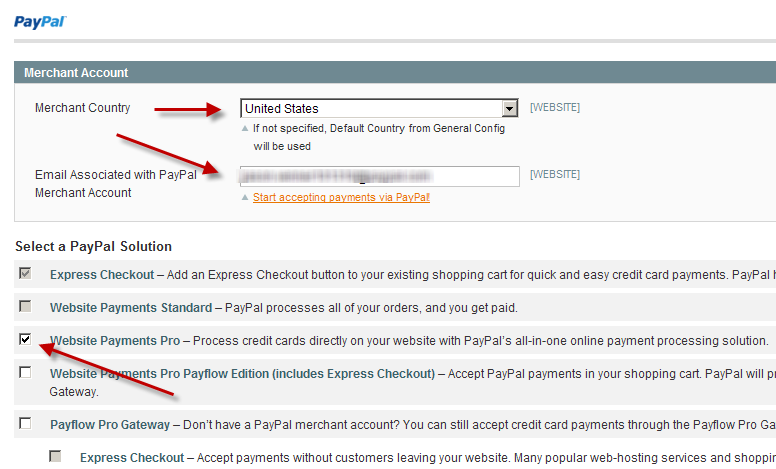
Magento PayPal Integration
A) Link your PayPal account to your Magento store in the Merchant Account Panel by selecting the appropriate options.
B) Choose which PayPal payment modules you want in the Select a PayPal Solution Panel:
Express Checkout
Website Payments Standard
Website Payments Pro
Website Payments Pro Payflow Edition (includes its own Express Checkout)
Payflow Pro Gateway
Express Checkout with Payflow Pro Gateway
C) The configuration panel corresponding to the payment method you’ve chosen above will open.
Enter the appropriate information and press the “save configuration” button in the upper right corner.
The process of configuring PayPal can be a bit tricky, you may want to consider getting a professional to handle the heavy lifting, especially where custom design work is involved – you don’t want to jeopardize your site performance. Please visit Magento PayPal Integration by Hara Partners; don’t wait until you’ve already lost sales – add more payment options to your Magento ecommerce store with Magento PayPal integration today.
Aesthetics/branding and SEO -mastery of these two integral regions of eCommerce is considered of the utmost importance to a successful online business, and rightly so – failure to attain a minimum in either of will almost certainly spell missed sales and ultimately a failed business. However, the flip side of the coin, oft ignored, is that too much focus on these areas can lead to budding businesses overextending themselves financially which again often ends in failure. That’s why Hara Partners recommends Magento eCommerce – the feature rich, open source platform contains all the tools you need to create a functional site without breaking the bank.
Magento eCommerce Platform:
The Magento eCommerce platform comes fully loaded with all the tools needed for a successful e-business, like analytics and marketing etc. or, at the very least, basic versions of those tools. Though the stock Magento toolkit may not be as robust or complete as some of the standalone options out there, they are more than sufficient for the new business to get to the point at which the numbers can justify the cost of the upgrade. And once it is time to upgrade having access to the massive library of extensions, themes and add-ons in the MagentoConnect marketplace means more, and usually, thanks to the stiff competition there, cheaperss expensive choices for you.
Aesthetics/Branding:
Let’s talk design. There is no doubt that when it comes to revenue streams for the small business nothing can compare to direct traffic – the kind that comes from word of mouth, or social advertising – for profitability. However, gaining market share through popularity means having strong customer loyalty and that most often comes through crafting a brand identity to which customers relate, ultimately creating a us (you and the customer) vs. them mentality. The problem is custom design work for a simple retail website runs somewhere in the tens of thousands – and that’s without the added costs of resolving any optimization issues the new design heavy site has – and spending that kind of dough just isn’t feasible for most small businesses. Magento eCommerce to the rescue! Creating custom designs is significantly cheaper on Magento that other systems because Magento eCommerce was created with an emphasis on flexibility so there is less shoehorning required than with other platforms. But the real goldmine is in the myriad themes available for free-or-almost-free in the Magento eCommerce marketplace which allow e-tailers to craft a unique image for themselves without breaking the bank.
Search Engine Optimization:
Search Engine Optimization (SEO) means making your website more “visible” to search engines so that your business is returned when relevant search terms are entered. This is what SEO professionals call “organic search” and, after direct traffic, it’s considered the best source of profitable traffic. SEO services, therefore, are in high demand and thus retaining SEO services can be quite costly, depending on the aggressiveness of the campaign and other variables. Problems can crop up in one or both of two ways. Firstly, finding an SEO professional who can actually achieve all the results they claim is tough, and the good ones are really expensive. And second, the whole industry involves taking advantage of Google (or other search engine) algorithms to raise search standing – what happens when the algorithms change? The answer, again, is Magento, and for the same reasons as above – it just doesn’t make sense to pay for services that you already get for free, and Magento comes loaded with a functional, albeit rudimentary, stock Magento SEO module so take advantage.
Make no mistake, this post in no way intends to diminish the importance of SEO and branding (or any other facet of eCommerce) to new online businesses – because both are absolutely vital to the long term success of any e-tail operation. However, it is my intent to disabuse the eCommerce beginner of the notion that the only way to “get a lot is to pay a lot” and to educate prospective e-tailers about the Magento eCommerce platform as a way to take get ahead of the curve and make educated decisions before committing to expensive and unnecessary solutions.
To find out how Hara Partners can help you create the ultimate Magento eCommerce store.
To read more: Why Magento – Hara Partners Blog
A watershed moment in online retail is quickly approaching—we may be on the brink of a bona fide online sales tax bill. Of course, any commentators worth their salt have been on this issue for years now. But the stakes have changed: the U.S. Senate approved a pending bill Monday, with the House scheduled to make a decision shortly. President Obama seems in favor of the legislation, as well. The heat’s on! Whether or not you support the idea behind the law—that debate alone could easily occupy a month’s worth of blogging—certain logistical elephants will have to be scooted around should it pass. Thanks in large part to Dale Traxler, today’s blog will address just that: operational requirements, related legislation, and lingering questions in need of clarification.
A Quick History Lesson
A Supreme Court decision in 1992 set the ground rules for e-commerce. Understandably, the technology at the time couldn’t accommodate the thousands of separate sales tax jurisdictions involved in nationwide or global order fulfillment. Accordingly, they ruled that merchants couldn’t be held responsible for tax collection or payment except in states where they had a physical presence—a “nexus.” While this may seem relatively easy to grasp, the intervening 21 years have produced quite the snarl of state laws, a shifty definition of “nexus,” and more than a few lawsuits.
Online Sales Tax, Clarified?
Enter the Marketplace Fairness Act of 2013, designed to alleviate these issues once and for all. Except, does it? Let’s take a look at the bill itself, summarized below:
• The bill applies to all e-tailers exceeding the “small seller exception”—annual U.S. sales over $1M. Small sellers are exempt.
• Any state belonging to the Streamlined Sales Tax (SST) Governing Board can mandate the collection of sales/use taxes from 90 days after enactment (22 states are currently members).
• Non-SST states that meet alternative criteria may also take part. If the legislation passes, expect more states to simply join the SST.
• States must provide free calculation/collection software to retailers.
• The bill explicitly precludes new “Internet taxes” beyond those already imposed by states and municipalities.
• The bill applies to online, physical, and multi-channel retailers alike.
So?
It’s not as cut-and-dry as some make it out to be. You can’t just grab any free software and be good to go. E-tailers will have to consider and/or implement the following:
• Only SST-certified software qualifies, and it may require complicated integration procedures.
• Once software’s in place, you’ll still have to monitor the entire sales cycle to ensure full compliance, including returns, sales tax refunds, and synchronization with existing systems.
• Timely payments to tax agencies and cash flow management.
• Evaluation of higher pricing in your competitive landscape.
Accounting
But wait, there’s more! Depending on your needs and sales volume, you may also want to track sales tax collections by state. This requires reconfiguration of your financial system and advanced functionality to coordinate transactions from the shopping cart. Plus, you’ll need to keep track of liability by state when collecting unpaid taxes; again, this plays into cash flow allocation, and it will require easy return processing and management. At the risk of beating a dead horse, pricing is the biggest issue here. You’ll probably have to reevaluate your standing in comparison with local retailers when sales tax needs to be factored in. And what about shipping costs on top of that? These questions can’t go unanswered.
Certified Online Sales Tax Software
Luckily, among the certified software providers is our valued partner CCH, offering SalesTax.com to streamline and automate many of the necessary processes. Our SalesTax.com Magento Connector even integrates their software with your Magento platform! Of course, it all depends on your goals and capabilities as a business—but not adapting is a surefire way to fail. Remember, if the bill’s in consideration now, it could conceivably come into effect smack dab in the middle of the holiday season. And get in touch with us if you’re unsure—it’s what we do!
This past Monday, May 5 2013, the Marketplace Fairness Act of 2013 passed through the Senate, halfway on its journey to becoming law. The bill, which once passed will allow states and local jurisdictions to collect sales and use taxes from online merchants – even if they have no physical presence in that state (called a “nexus”) has the backing of President Obama but still needs to pass through Congress, where it is expected to be met with a not-inconsiderable amount of resistance.
Image: CNN
A bit of background:
The current state of internet sales tax laws, a company is only responsible to collect and remit sales tax on behalf of states in which they have a nexus, stems from the ruling rendered by the Supreme Court in the landmark Quill office-supply case. The Supreme Court’s decision was based on the logic that it would be crippling, and most likely impossible, for companies to keep abreast of the myriad tax laws across the nearly 10,000 districts. As eCommerce grew brick and mortar stores found that they were losing sales to their online counterparts and States found themselves with billions in lost tax revenue. Coupling those facts with technological advances which automate all the accounting requirements, largely removing any burden from e-companies, led lawmakers to decide it was time to make a change (but mainly it was the billions in tax revenue).
Who’s going to be affected?
The Marketplace Fairness Act of 2013 would allow any state which is a member of the Streamlined Sales Tax Governing Board to mandate the collection of sales and use taxes beginning 90 days after the bill is enacted; currently the SST has 22 member states. Nonmember states would be required to meet certain requirements and supply free software to collect sales tax, or they could just join the SST – a far more likely scenario; businesses with less than $1million in yearly sales are exempted. Finally, this bill is not going to create any sort of new Internet tax, it is simply a way for states to collect their usual sales tax.
What you must do to become compliant:
At this time there are 6 companies whose sales-tax solutions are approved by the SST, to become compliant e-tailers would need to implement one of these. Unfortunately, these 6 products aren’t compatible with many platforms, and integrations can be tricky and costly for others. There is no word what will happen with those websites who use incompatible platforms.
My Thoughts:
The whole thing seems kinda overblown, right. I mean, what’s the big deal? You add some software, when April comes it tells you how much to pay in taxes – bada-bing bada-boom you’re done. Well, it’s a bit more involved than that. Firstly, even though the bill requires states to provide the appropriate software free to merchants there are still costs which will be incurred, like installation and integration, and future tax liability issues which are sure to creep up. Additionally, while it may be that at some point all the attendant processes may be automated at this time there is nothing built to handle returns or losses and accounting software is currently not built to maintain separate sales tax listings for each state and making it so will require businesses to spend many man-hours and much money. Finally, there is simply no telling how the loss of the competitive edge gained by the lack of sales tax will affect e-businesses. My advice to merchants is to immediately begin researching what the new law will mean to you: Do any of the free software packages work for you? Is your accounting software capable of handling the increased workload? There is a strong possibility that the bill will come into effect around the upcoming holiday season so there’s no time to waste.
NetSuite Buys OrderMotion, Fleshes Out E-Commerce Portfolio
NetSuite is beefing up its cloud-based ERP software’s order-processing features by acquiring OrderMotion, a move that could strenghten its appeal to customers in retailing.
Terms of the deal, announced Wednesday, were not disclosed.
OrderMotion’s technology is aimed at companies that ship products directly to consumers. This is a business that ahs become more complex of late, thanks to ship-to-store programs, where a customer orders a product online and heads to a retail location to pick it up.
In addition, companies are increasingly looking to use their retail locations as regional distribution centers in order to save time and money compared to using a massive, centralized warehouse operation, said Andy Lloyd, general manager of commerce products at NetSuite.
OrderMotion’s software is used in conjunction with e-commerce applications such as Demandware, as well as NetSuite’s own SuiteCommerce software. NetSuite won’t necessarily attempt to push OrderMotion customers toward its own offering, however, according to Lloyd.
“Generally when we do acquisitions, the directive we get from CEO Zach Nelson is ‘don’t break it…. Still, when a company is operating on a single system and has one view of the data, systems work best and companies run best.”
Netsuite’s software runs on the Oracle technology stack. OrderMotion, however, is based on Microsoft .NET. While “some cross-pollination is going to take place,” another consideration behind the acquisiton is the high quality of OrderMotion’s senior technical staff, who will be joining NetSuite.
This is not the first acquisition NetSuite has made in the retail software arena, coming after its recent purchase of mobile point-of-sale vendor RetailAnywhere.
Forrest Research analyst China Martens said the OrderMotion acquisition is a smart move by NetSuite.
“Order management is an area that has tended to be somewhat neglected by both business app vendors and customers,” Martens said via email. “Since it can be rather diffuse, elements of order management sit within CRM, ERP, and SCM, and then somewhat alone and disconnected between those apps. Naturally that siloing, and often a lack of full process automation, has led to issues.”