E-commerce, short for ‘electronic commerce,’ entails the trading in products or services using computer networks such as the Internet.
E-commerce draws on technologies such as mobile commerce, electronic funds transfer, supply chain management, Internet marketing, online transaction processing, electronic data interchange (EDI), inventory management systems, and automated data collection systems.
Below you’ll find a bunch of our posts related to e-commerce. Some of the topics that our company bloggers cover include magento e-commerce, and the best ecommerce sites that are currently active on the web. Because e-commerce is a wide and expansive field that is constantly growing, our team is constantly on the go to cover all the latest and greatest news associated with e-commerce.
Since Hara Partners is an e-commerce solutions company, all of the e-commerce going-ons in the world are of the most maximal concern to us. Some of the topics that we covered in the past include Asian e-commerce, mobile e-commerce platforms, and e-commerce trends.
For your information, we’ve also listed some of the common types of e-commerce platforms below:
On Premise E-commerce:
On-premise E-commerce software usually requires initial one time purchase investment in terms of licensing fees. Also, it implies extra costs related to hardware and installation services as well as data migration and on-going maintenance fees that are usually charged on a yearly basis for software updates and support. Some examples of typical on premise E-commerce platforms are Hybris, Sanna Commerce, Oorjit, and IBM WebSphere.
Software as a service (SaaS) E-commerce:
Software as a Service (SaaS)- is a cloud based delivery model in which applications are hosted and managed in a service provider’s datacenter, paid for on a subscription basis and accessed via a browser over an internet connection. Two examples of typical SaaS E-commerce solutions are Shopify and Demandware.
Open Source E-commerce:
Open source e-Commerce is a free of charge platform that doesn’t imply licenses fee. Furthermore, open source users are also responsible for installing, maintaining, securing and configuring the software on their own servers. In order to set up an open source platform, basic technical expertise is required in the areas of web design and development. Software products that are distributed as open source are generally free, and users can access and modify the source code. Three examples of typical open source E-commerce platforms are PrestaShop, osCommerce, Magento and Thelia.
Chris Schreiber is director of marketing at social video advertising company Sharethrough. A leading expert on social content strategy, Chris recently presented a two-hour workshop on viral video at the Cannes Lions festival, entitled “Making Videos Go Viral: Creative, Social, and Technological Techniques.”
Last week, the world’s top brands and agencies descended on the Cannes Lions festival to discuss creativity in modern advertising and to anoint the campaigns that most effectively captured our imaginations. While the conference was renamed this year to the “International Festival of Creativity” (previously the “International Advertising Festival”), it featured an unprecedented amount of participation from blockbuster technology companies such as Google, Facebook and Microsoft.
Over the course of the week, the significant relationship between the powerful new forces in technology and the creative output from the advertising industry became quite clear. As the web increasingly empowers us to choose and share the media we care about, brands genuinely commit to creating content and experiences that thrive in our on-demand culture.
In this article there are five video’s which show different themes of majors changes of the world of advertising.
[ A New Wave of Experimental Marketing]
The first video was a nike commercial which showed different soccer player’s showing a future glimpse of what would happen if they make their goal. The visuals were compelling and action packed.
[Content, Not Ad’s]
Unlock the formula was Coca Cola’s video which showed multiple images and clips of coca cola and the secret behind their formula. What made it special was the usage of cultural content in it, showing different time periods but have a connection due to coca cola. The overall feel of this ad had a little creepy side to it.
[ The Shift from Communities to Collectives]
An ad for Sneakerpedia which is a wikipedia style site powered by Footlocker for “sneakerheads” to document the history of sneakers. It’s the buzz of this site that makes it sucessful.
[ The rise of the “Creative Technologist”]
Advertising is becoming digital and agencies are looking to bring in more developer talent to help create new and original products. Interactive media is becoming an essential to advertising these days.
Last but not least the [ The Gaga Effect]
The Gaga Brand has been taken globally where people all over the world can say that they would know who Lady Gaga is. By using digital tools she broadens her fan base all over the world.
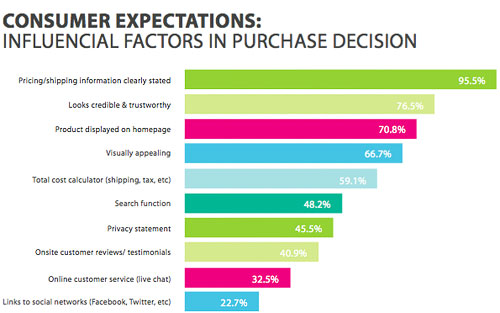
Continuing with the findings of the previous article where we found these two usability points that induce customers to buy or not:
Clear communication of price and total cost
An overall professional and trust-inducing look
At the base of the second point is a clean and visually appealing look. I will not list any bad examples here as there are plenty of these and while they make me a little sad, I know you have seen them.
However, “visually appealing” ranks behind a “credible and trustworthy” look and “products displayed on homepage”, which we take to come from the overall user-interface and information flow.
The e-commerce arena has become increasingly competitive in terms of technical requirements. While you could get away with a basic “cart” in the late 90’s, nowadays even entry-level online stores are expected to provide the an extensive functionality list. This certainly is the main reason why Magento, the leading open-source platform enjoys so much popularity.
What we gather from these findings is that the stakes have gone up significantly, and that looks and user experience have to be delivered at a high level and go hand in hand to maximize sales.
A recent e-commerce usability study hones in on the key purchase decision factors for consumers on e-commerce web site. The top five answers center around only two points:
Clear communication of price and total cost
An overall professional and trust-inducing look
These findings should not come as a surprise. Online sales have become more competitive with more players entering the arena.
The first point is relatively simple to excel in and provide a satisfactory customer experience. However, we still speak to many store owners coming from a brick and mortar background explaining that they cannot compete on price alone. And they express the desire to hide or obfuscate the total purchase price.
Most of these stores dismiss their comparative advantages, such as superior personal customer service, or a greater selection with more options than their competitors. The challenge is to translate these benefits onto the web.
We have also seen clients embrace the web and offer an online catalog, in addition to a print catalog, where they try to provide a product configuration tool with the aim for customers to ultimately call and place an order. This is the way to embrace the findings of this study and reach out to a greater audience. Yes, you will always have people come to your web site and look at the price and buy elsewhere, but you will also gain long-term customers who appreciate the extra customer service and positive experience you bring to the table and buy from you again and again.
One of the biggest technology companies, Oracle, is following other industry heavy weights such as Google into the e-commerce arena by making a substantial investment with buying one of the leading e-commerce platform providers ATG.
It’s interesting to see how the e-commerce field will evolve after other big deals such as GSI’s purchase of Rue La La and Rakuten and Baidu partnering up in the Chinese market.
It remains to be seen how Magento’s taking in a large investment earlier this year will play out.