E-commerce, short for ‘electronic commerce,’ entails the trading in products or services using computer networks such as the Internet.
E-commerce draws on technologies such as mobile commerce, electronic funds transfer, supply chain management, Internet marketing, online transaction processing, electronic data interchange (EDI), inventory management systems, and automated data collection systems.
Below you’ll find a bunch of our posts related to e-commerce. Some of the topics that our company bloggers cover include magento e-commerce, and the best ecommerce sites that are currently active on the web. Because e-commerce is a wide and expansive field that is constantly growing, our team is constantly on the go to cover all the latest and greatest news associated with e-commerce.
Since Hara Partners is an e-commerce solutions company, all of the e-commerce going-ons in the world are of the most maximal concern to us. Some of the topics that we covered in the past include Asian e-commerce, mobile e-commerce platforms, and e-commerce trends.
For your information, we’ve also listed some of the common types of e-commerce platforms below:
On Premise E-commerce:
On-premise E-commerce software usually requires initial one time purchase investment in terms of licensing fees. Also, it implies extra costs related to hardware and installation services as well as data migration and on-going maintenance fees that are usually charged on a yearly basis for software updates and support. Some examples of typical on premise E-commerce platforms are Hybris, Sanna Commerce, Oorjit, and IBM WebSphere.
Software as a service (SaaS) E-commerce:
Software as a Service (SaaS)- is a cloud based delivery model in which applications are hosted and managed in a service provider’s datacenter, paid for on a subscription basis and accessed via a browser over an internet connection. Two examples of typical SaaS E-commerce solutions are Shopify and Demandware.
Open Source E-commerce:
Open source e-Commerce is a free of charge platform that doesn’t imply licenses fee. Furthermore, open source users are also responsible for installing, maintaining, securing and configuring the software on their own servers. In order to set up an open source platform, basic technical expertise is required in the areas of web design and development. Software products that are distributed as open source are generally free, and users can access and modify the source code. Three examples of typical open source E-commerce platforms are PrestaShop, osCommerce, Magento and Thelia.
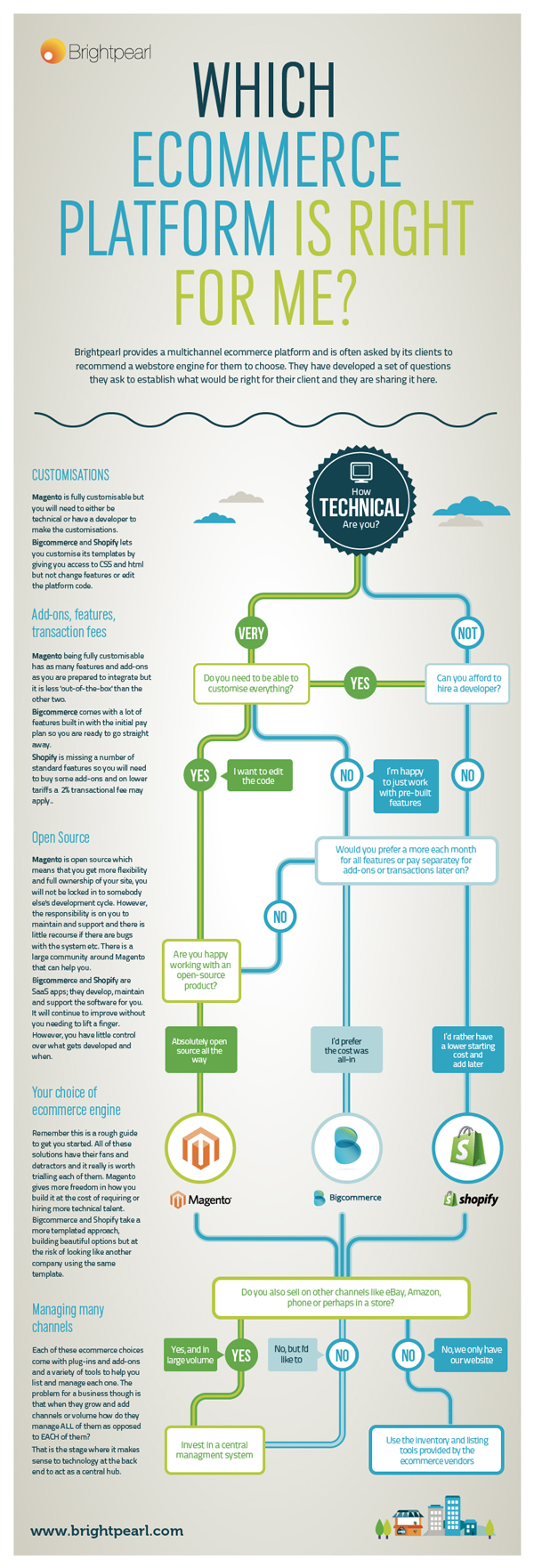
Erin Lynch at Multichannel Merchant brought our attention to Brightpearl’s outstanding infographic, a useful tool for differentiating the strengths of three major e-commerce platform engines: Magento, Bigcommerce, and Shopify. We’re obviously biased towards Magento, but it can only help to clarify the often murky explanations of its benefits. This chart does just that, offering a step-by-step approach, with explicit yes/no paths, for determining the appropriate e-commerce platform from an entrepreneur’s perspective.
Here are some of the major points they raise. Want more? Take a look below!
• Like we always say, Magento is the most technical of the bunch. In addition to CSS and HTML tweaks, it grants you full feature control and the ability to go right into the platform code and edit away. The same can’t be said for the other two.
• The easiest out-of-the-box solution is Bigcommerce, followed by Shopify. While these may be better for the grab-and-go types, Magento stands head and shoulders above them in terms of performance scope—the only limit to modules and integrations is your budget and imagination.
• Open source can be a point of contention for some. With Magento, you can truly claim full ownership of your build, though the onus is on you to sweep out any bugs or misconfigurations. Luckily, a large and welcoming Magento community populates web forums, brimming with answers and workarounds. As SaaS solutions, Bigcommerce and Shopify do all the heavy lifting for you, with the provision that updates and tweaks are on their schedule, not yours.
• Many online retailers eventually want to expand to other channels—eBay, Amazon, brick and mortar, etc.—which require additional functionality. In these cases, no single e-commerce platform comes already equipped to handle everything. Magento’s advantage here, again, is its broad community dedicated to open-source modules, addressing needs as they arise in a well-supported ecosystem. It isn’t easy, but the answers can be found with diligence and flexibility.
“What was going through your mind when you bought that?” Now, thanks to this awesome infographic from the folks at moneysupermarket.com, you can finally answer the age-old question about how our brains influence our eCommerce spending habits:
eCommerce Spending Demystified
Which part of your brain were you using when you made the decision?
The mesial prefrontal cortex which makes decisions based on personal preference, before money comes into play.
The insular cortex where you feel actual pain relative to spending money, pushing you to make more financially responsible (read: cheaper) choices.
The nucleus accumbens, the gambler in our brain, which urges us to go ahead with decisions it feels will pay off in the end, ignoring the other parts of our brain and that feel less-than-confident.
What do casino chips, one-click-ordering, budget panning all have in common? They are all tricks designed to fool our insular cortexes by replacing actual cash, or even the very act of removing ones wallet from their pocket, with abstract tokens to reduce the pain related to spending.
Knowing how we are constantly manipulated can help you curb overspending.
Begin building your Magento store today with Hara Partners
Welcome back once more! This is the third article of three covering the challenges and concerns of e-tailers looking to expand operations into Asian e-commerce. Through a mix of mini case studies, relevant metrics, and solution strategies, we’ll explore the issue from the inside out. If you need to get caught up, please take a few minutes to read Part I and Part II before continuing. If not, let’s go!
Tech in Asian E-Commerce
Picking up where we left off, let’s take a look at how Zazzle was able to launch its international sites so quickly. Thanks to purpose-built data transfer and international-friendly modules, Zazzle was able to launch dual e-commerce sites in Australia and Japan with a few months of each other in 2010. For its Japanese site, Zazzle’s commitment to all-Japanese product descriptions and customer service, as well as yen-centric pricing structures, significantly eased the transition. Moreover, they collaborated with Transcosmos Inc. to arrange call center services and specialized marketing programs ahead of time, incorporating SEO and paid search utilities geared towards Japanese keywords and search habits. Their success is more or less directly attributable to these preliminary efforts.
Same goes for Newegg, the heroes of Part I in this series, whose use of internal technology and a substantial team of Chinese designers and programmers was pivotal in the launch of Newegg.com.cn. The eternal question for Western e-tailers looking to break in is one of differentiation: facing the inarguable success of native Asian e-commerce entities, how do outsiders distinguish themselves?
Newegg cobbled together an answer out of several important components. Their delivery network capitalized on regional carriers to extend the convenience of next-day shipping to several Chinese urban epicenters. They also ported in proven perks like live chat, longer warranties, and packaged installation services. Localization is the name of the game—they’ve become masters at representing it in the Newegg web experience.
Extending the Establishment
When it comes to established brands, sometimes existing momentum can do a lot of work. Take chain retailer Gap, whose national network of approximately 130 stores across its constituent brands in Japan has been in development since 1994. Thus, when they launched their Asian e-commerce site just last October, they had a successful operational infrastructure already in place. Customer favorites such as universal shopping carts and free local shipping were easily and efficiently integrated from day one. And many of their customer experience features translated well with Japanese customers, who loved Gap’s size charts, multi-angle photos, color switching, and zooming. They capped the experience off with return merchandise capabilities and dedicated Japanese content—all elements giving customers the “ability to shop how, when and where they want,” according to Gap Senior Director of Asia online Iris Yen.
The Final Word
Entering Asian e-commerce markets is largely a matter of bypassing expensive startup mistakes. There’s such diversity that U.S. retailers really need to focus on one or two to begin with. Experts put consumer involvement in emerging markets in terms of a four-stage evolution:
1. Once they have a device paired with a reliable internet connection, they start by exploring web content and using social media.
2. Then they take basic e-commerce steps: booking travel, etc.
3. Next they seek out entertainment: books, music, movies, etc.
4. Finally, having become fully integrated into the online shopping mentality, they purchase from the full spectrum of products: apparel, electronics, healthcare, even groceries.
Knowledge of your consumers’ place in this evolution is crucial and can truly mitigate the difficulties of the process. Circling back to Newegg, timing played a huge role in their astounding success when they entered the Chinese market. At the time, the foundation for e-commerce was in its infancy, and the Chinese government actively encouraged foreign investment with tax breaks. It was the right place and the right time for Newegg to step up and meet a growing demand. But perhaps most important of all was Newegg’s commitment to fostering regional relationships with existing Chinese businesses. Their continued success, and yours, is proportional to the recognition of and support for an emergent, consumer-driven market.
The Biggest Gainers in Asian E-Commerce Markets
Format: Retailer — 2012 Web Sales — 2011 Web Sales — Growth
NOTE: many of these figures are based on Internet Retailer estimates
AUSTRALIA
JB Hi-Fi — $52.9M — $29.9M – 77.2%
The Catch of the Day Group — $302M — $198M — 52.53%
CHINA
Suning Commerce Group Co. Ltd. — $4.76B — $945.1M —403.67%
Welcome back! This is the second article of three covering the challenges and concerns of e-tailers looking to expand operations into Asian e-commerce. Through a mix of mini case studies, relevant metrics, and solution strategies, we’ll explore the issue from the inside out. Check out Part I for an introduction to the topic. Let’s go!
Making Inroads in Asian E-Commerce
Iconic retailer Macy’s used its considerable resources to team up with FiftyOne Inc. and VIPStore, securing a delivery agreement with the former and a marketing deal with the latter to spearhead an initiative aimed at Chinese web shoppers (predicted to surpass 400M consumers by 2017, according to eMarketer Inc.). Even for a mammoth entity like Macy’s, understanding the habits and predilections of Asian online shoppers can be a struggle.
Just look at The Home Depot Inc., which announced in September imminent plans to close seven big-box stores in China due to China’s lackluster response to its stars-and-stripes DIY approach. In arena where success hinges on a sustainable e-commerce base, you’ve simply got to play to your audience better. And they will: instead of going it alone, they plan to cut the risk via a possible alliance with 360Buy Ltd., #3 on Internet Retailer’s list of the top ten Asian e-commerce retailers.
To the Amazon!
…or, more accurately, Amazon.com, who has Asian online market penetration down to a science. Their approach to Japan—notoriously tough customers ever since, well, the dawn of East-West trade—is practically textbook. Back in 2000, as one of the first U.S. retailers to enter the country, Amazon established a solid foundation by aggressively studying the buying and navigation habits among almost 193,000 Japanese customers already regularly using Amazon’s home site (again, there are benefits to extensive infrastructure and a robust market research team). From there, they built up a template for further action:
• Enter early
• Begin with a fully developed product inventory
• Utilize an intelligent and responsive customer service program
• Build site features around local shoppers’ preferences
Concurrently, they developed physical properties to facilitate large-scale logistics: a headquarters in Tokyo, regional distribution centers, and customer service centers. These efforts paid off in spades: from its amazon.com.jp property, an all-Japanese bookstore comprising 1.7M books by Japanese authors or popular translations, the company milked the region into its second-largest foreign market with $7.8B in 2012 sales, accounting for more than a quarter of Amazon’s 2012 international sales.
“Amazon likes to do its homework and make a big enough investment in all the right things to position itself to grow as the market grows,” quips Scot Wingo, ChannelAdvisor CEO. Indeed!
The Saga Continues
Of course, the battle is far from won. Amazon.com may seem to be sitting pretty with 11 Japanese distribution centers and 50M products on amazon.com.jp, but it still defers to Rakuten Inc., the market leader with 2012 estimated sales of $9.76B. Efforts continue to expand and revitalize Japanese operations. Like what? Try the Kindle Paperwhite and Fire tablets, recently released in Japan alongside a Kindle bookstore hawking Japanese digital content. There have also been strong initiatives to augment its fashion and food product offerings, as well as plans to fortify same-day delivery to more of western Japan.
“Amazon is setting the bar,” says Wingo, “[that] a lot of other U.S. and Japanese retailers will have to meet.” Yet they aren’t sitting idly by—they’re taking cues! Amazon took about 18 months to launch its first Asian e-commerce site, whereas Zazzle was able to up the ante since then via quicker data transfer between its systems and sites. According to CFO Jason Kang, Zazzle anticipated these challenges, incorporating codes and modules accommodating a variety of languages and currencies when it developed its internal e-commerce platform in 2005. All told, this cut the time to go-live for its Asian e-commerce site by half.
The Ten Fastest-Growing E-Retailers in Asia
Format: Retailer (Country) — Asia 500 Rank — 2012 Web Sales — 2011 Web Sales — Growth
NOTE: many of these figures are based on Internet Retailer estimates
Mark Brohan, Internet Retailer Research Director, published a comprehensive write-up of the goals and opportunities for e-tailers looking to break into the world’s largest e-commerce market—none other than our largest continent, Asia. Even a cursory glance at the figures yields a knockout $377B in 2012 online sales, over $151B more than U.S. figures in the same period. China alone estimated about $179B in 2012. But the situation is not without its roadblocks. Read on for our coverage of this great reservoir of potential, comprising a three-post series on our blog.
A Case Study
Perhaps the best place to start is with an example: Newegg, a U.S.-based web-only electronics retailer with which you’re probably already familiar, began its mission to break into China more than ten years ago. Way back in 2001, at the dawn of the online shopping craze, the company began planning the initiative—and as native Taiwanese with cultivated relationships in the Chinese business world, they weren’t exactly debutantes. It still took a year for Beijing to approve a certified web merchant license. And that was just the start!
Consider logistics: $25M to finance a headquarters building, regional fulfillment hubs, and a bespoke delivery network incorporating area carriers. Oh, is that it? How about this: next they had to file and win a slew of lawsuits to snag their desired domain name (Newegg.com.cn), followed by the mind-bogglingly complicated process of devising an effective Chinese-centric e-commerce strategy. It’s truly a different animal, and the only way to proceed in such an unfamiliar environment was by trial and error.
But it paid off! Now #28 in Internet Retailer’s 2013 Asia 500, Newegg scored Chinese web sales around $400M in 2012, with business growth topping 50% year-over-year. Big investment, big risk, big rewards.
The Plot Thickens
It’s clear that a substantial up-front investment and oodles of product and market research are the basic requirements for success in Asian e-commerce. The problem compounds exponentially, though, once you consider the abundance of languages, currencies, and commercial codes across the Asia-Pacific region. And those who achieve even paltry market penetration find themselves facing entrenched competitors with strong national customer bases. It quickly becomes apparent that U.S. retailers hoping to succeed must scale back their ambitions to just a few markets, then follow up with plenty of market research.
One solution works around these obstacles by making local acquisitions or forming joint ventures with Asian e-commerce stalwarts (Walmart et al.). Other merchants—Amazon, Zazzle—study up with due diligence for the slow and steady route. A lucky few (Gap) can leverage global brand recognition to expand their store base into Asian e-commerce. All for good reason: collectively, the nine largest regional Asian markets (Australia, China, India, Indonesia, Japan, New Zealand, South Korea, Taiwan, and Vietnam) outpace both U.S. and European web sales. You can’t really blame them for trying.
To India!
Let’s focus on India for more site-specific examples. Ranked fourth in the world economy, India nevertheless lags behind in e-commerce. Recognizing encouraging recent growth trends, quite a few non-Indian companies are keen to stake out that virgin territory. And standing right in their way is the Indian government, whose policies restrict e-commerce companies with foreign backing from selling directly to consumers or owning more than 51% of an Indian retail organization. In effect, limiting companies like Amazon to B2B web sales cripples their chances at securing substantial market share. This holds true for most of Asian e-commerce: compliance can be a huge wrench in the gears, or at least an extended time sink. To be fair, some Indian regulations mandate contributions to the e-commerce ecosystem as a whole: any e-commerce investments must be accompanied by investments in infrastructure and agreements to include local businesses in supplier networks.
Coupled with an infant market and a lack of widespread credit card ownership, this engenders a frustrating Indian marketscape, to say the least. Think tens of thousands of small-scale enterprises, unsecure payment processing—not to mention the headaches when arranging fulfillment and delivery to the 60% of the population living outside major urban areas. According to Avnish Bajaj, Matrix Partners India co-founder and director, the weak infrastructure holds off many, but it won’t be long before a projected customer base of 300M shoppers within the decade attracts serious investors.
Mark Inkster, SVP of Vistaprint (a retailer of custom printing products), agrees, noting that India’s 800K+ small businesses constitute an ideal customer base. Vistaprint broke in by acquiring Printbell, a Mumbai printing products and B2B e-commerce services company, in 2011. The acquisition and concurrent $5M investment outfitted Vistaprint with existing facilities, affordable overhead, and established Indian e-commerce expertise, ultimately enabling relaunch in about a year. The results? Rapid organic growth reflected in Vistaprint’s impressive Asian e-commerce metrics for 2012: $61.2M and 44% growth.
The Top 10 Asian E-Commerce Retailers
Format: Retailer (Country) — 2012 Web Sales — 2011 Web Sales — Growth
NOTE: many of these figures are based on Internet Retailer estimates
Alibaba Group (China) — $170B — $101.549B — 67.41%
A watershed moment in online retail is quickly approaching—we may be on the brink of a bona fide online sales tax bill. Of course, any commentators worth their salt have been on this issue for years now. But the stakes have changed: the U.S. Senate approved a pending bill Monday, with the House scheduled to make a decision shortly. President Obama seems in favor of the legislation, as well. The heat’s on! Whether or not you support the idea behind the law—that debate alone could easily occupy a month’s worth of blogging—certain logistical elephants will have to be scooted around should it pass. Thanks in large part to Dale Traxler, today’s blog will address just that: operational requirements, related legislation, and lingering questions in need of clarification.
A Quick History Lesson
A Supreme Court decision in 1992 set the ground rules for e-commerce. Understandably, the technology at the time couldn’t accommodate the thousands of separate sales tax jurisdictions involved in nationwide or global order fulfillment. Accordingly, they ruled that merchants couldn’t be held responsible for tax collection or payment except in states where they had a physical presence—a “nexus.” While this may seem relatively easy to grasp, the intervening 21 years have produced quite the snarl of state laws, a shifty definition of “nexus,” and more than a few lawsuits.
Online Sales Tax, Clarified?
Enter the Marketplace Fairness Act of 2013, designed to alleviate these issues once and for all. Except, does it? Let’s take a look at the bill itself, summarized below:
• The bill applies to all e-tailers exceeding the “small seller exception”—annual U.S. sales over $1M. Small sellers are exempt.
• Any state belonging to the Streamlined Sales Tax (SST) Governing Board can mandate the collection of sales/use taxes from 90 days after enactment (22 states are currently members).
• Non-SST states that meet alternative criteria may also take part. If the legislation passes, expect more states to simply join the SST.
• States must provide free calculation/collection software to retailers.
• The bill explicitly precludes new “Internet taxes” beyond those already imposed by states and municipalities.
• The bill applies to online, physical, and multi-channel retailers alike.
So?
It’s not as cut-and-dry as some make it out to be. You can’t just grab any free software and be good to go. E-tailers will have to consider and/or implement the following:
• Only SST-certified software qualifies, and it may require complicated integration procedures.
• Once software’s in place, you’ll still have to monitor the entire sales cycle to ensure full compliance, including returns, sales tax refunds, and synchronization with existing systems.
• Timely payments to tax agencies and cash flow management.
• Evaluation of higher pricing in your competitive landscape.
Accounting
But wait, there’s more! Depending on your needs and sales volume, you may also want to track sales tax collections by state. This requires reconfiguration of your financial system and advanced functionality to coordinate transactions from the shopping cart. Plus, you’ll need to keep track of liability by state when collecting unpaid taxes; again, this plays into cash flow allocation, and it will require easy return processing and management. At the risk of beating a dead horse, pricing is the biggest issue here. You’ll probably have to reevaluate your standing in comparison with local retailers when sales tax needs to be factored in. And what about shipping costs on top of that? These questions can’t go unanswered.
Certified Online Sales Tax Software
Luckily, among the certified software providers is our valued partner CCH, offering SalesTax.com to streamline and automate many of the necessary processes. Our SalesTax.com Magento Connector even integrates their software with your Magento platform! Of course, it all depends on your goals and capabilities as a business—but not adapting is a surefire way to fail. Remember, if the bill’s in consideration now, it could conceivably come into effect smack dab in the middle of the holiday season. And get in touch with us if you’re unsure—it’s what we do!
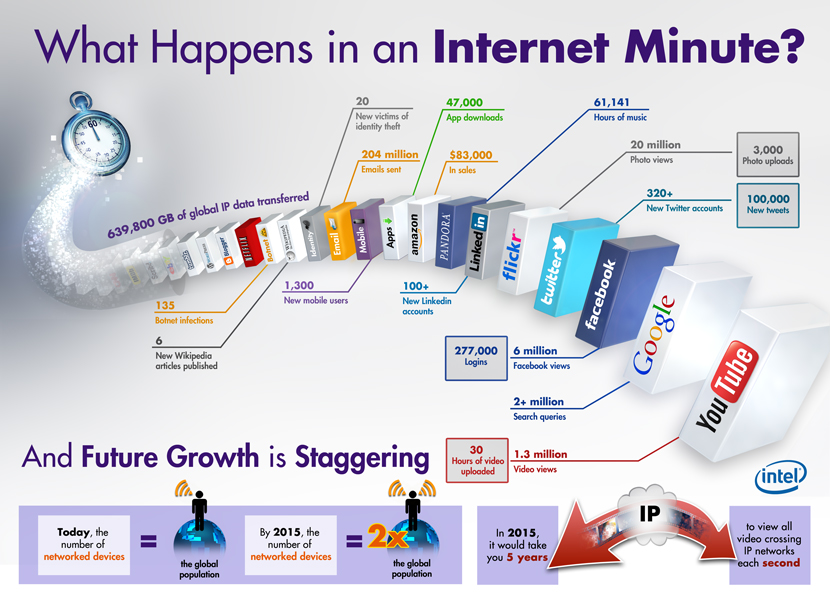
The folks at Intel decided to find out just how much data gets processed on the internet each minute, including eCommerce; their research led to the infographic displayed below.
Some of the highlights of what they discovered include:
In each internet minute:
A staggering 639,800 GB of IP data is transferred.
30 hours of video were uploaded to YouTube.
61,141 hours of music was streamed by Pandora.
20 Identities were stolen.
100,000 new tweets posted and 320+ new Twitter accounts were created.
Exciting news from Internet Retailer: despite grim sequester predictions and a general belt-tightening attitude, U.S. web sales have had quite the strong year in 2012, exceeding $225 billion and 15% year-over-year growth. In fact, this is the third year in a row of online sales growth topping 15%, as per the following figures from the U.S. Department of Commerce:
How does this compare with total retail sales? It leaves them in the dust with a mere 4.2% increase in 2012, excluding sales of automobiles and parts. The figures get even more dramatic when we look at just the fourth quarter with its holiday boost: web sales totaled $71.6 billion not adjust for seasonality, a 36.3% boost for Q3 2012. All told, that constitutes 13 consecutive quarters of year-over-year e-commerce growth above 12.9%. Now there’s cause for celebration!
Simply put, e-tail’s growing portion of total retail sales is here to stay. In 2012, it accounted for 5.2% of total retail spending; on a non-adjusted basis and excluding sales in categories not commonly bought online (cars, fuel, foodservice), that translates to a 7.6% share of total retail sales in 2012, up from 2011’s 6.8%.
This may seem like a bunch of sanctimonious number-crunching, but it does demonstrate the advancing rate of retailers’ investment in (and consumer comfort with) an online paradigm. Online retail has proven itself a sea change more profound than the vagaries of national economic climate or even popular trends. It’s a truly global phenomenon demanding customized, responsive vehicles from entrepreneurs in its midst. No longer can one’s online presence remain a token effort to “appease a demographic” or “get it over with”—we’ve entered the age of plugged-in grannies and e-wallets. The wave continues!
Welcome back! This article continues our exploration of a burgeoning online retail trend: same-day delivery. Is it worth it? How have companies fared? Read on for answers!
Broadened Spectrum
What about companies that already depend on same-day delivery for perishable or time-sensitive products—what do they stand to gain? 1-800-Flowers.com is using the USPS Metro Post service to expand delivery options for products besides flowers, including gourmet food brands. While it’s too early to gauge consumer reaction, the program is generating buzz and has already spread to other retailers in San Francisco in a region covering 26 ZIP codes.
To take full advantage of same-day delivery, it’s necessary to have a correspondingly robust infrastructure and communication system. Accurate, reliable data needs to be transmitted quickly to delivery companies in order to provide seamless service on the customer’s end. This is made much easier when companies already offer in-store pickup for online orders. Naturally, that trend is becoming common in the U.S. as well; with real-time inventory updates and intra-store merchandise allocation in place, transmission to outside delivery entities is made that much easier.
Complex Operations
The USPS Metro Post has the advantage of usage of its own trucks over courier-only services like Shutl and eBay Now, allowing it to accommodate web-only retailer like 1-800-Flowers with larger order volumes and extensive customer bases. They also use Postal Service software to calculate efficient routes for its four delivery vans in San Francisco. It can be tough to keep prices at or around standard ground shipping levels (~$10), but advertising certainly helps.
EBay Now’s model differs significantly: using a mobile app, customers locate the nearest available shopping assistant via built-in GPS, then tracks and communicates with the shopper if necessary to deliver a specific product on time. Shoppers can take advantage of eBay’s Milo system, offering mobile users real-time availability at nearby brick-and-mortar locations. They are also considering letting retailers set the price for promotions and other material usage. Again, it’s still too early to tell whether e-tailers will take to the service en masse.
Across the Pond
There are still some kinks to work out between Argos and Shutl, which have been involved since late 2010. Tests continue to evaluate pricing and discounts in the context of minimum order thresholds. They’re also weighing the benefits of free same-day delivery.
McCarthy is cautiously optimistic: “It is difficult to ascertain exactly the impact Shutl has had on customer conversion. The Shutl option is shown to the customer at the very end of their shopping journey and, theoretically, we have already converted the customer. However, from the repeat occurrences and the positive feedback we have received from users, it is both a fast and convenient way of getting goods to the customer, and offers yet another route that gives customers added choice and convenience.”
The cost of Shutl for retailers changes with the size of the order and the distance to the customer, but retailers can set their own price for their customers. They’ve been able to convert up to 45% of shoppers by keeping Shutl price at or below 5% of cart value.
Moving Ahead with Same-Day Delivery
As with most aspects of e-commerce, a balance must be found if same-day delivery hopes to take off. Covering e-tailers’ costs is important, of course, but everyone’s wary of repeating the mistakes of Urban Fetch and Kozmo.com. When they tried same-day delivery in the 1990s, they failed miserably because they overextended the service. Al Sambar of Kurt Salmon warns that same-day delivery has limited applications and absolutely isn’t right for every product, especially when the product itself can’t cover the cost of delivery. Convincing the customer with convenience and trustworthiness is the order of the day—only time will tell if online retailers rise to the occasion.
Paul Demery, Internet Retailer CTO, recently compiled some telling observations on the successes and challenges associated with same-day delivery for e-tailers. Below, a summary of his major points. This is Part I in a two-part series; be sure to check out Part II for the full story!
The latest trend in online retail seeks to appropriate a long-held brick-and-mortar advantage: receiving goods the same day you shop for them. Sure, there hasn’t exactly been an uptick in consumer demand for same-day delivery, but retailers are taking the usual “customers don’t know what they want yet” approach here; in tandem with delivery companies, they’re striving to shave overhead low enough to drum up interest. Some are even taking serious risks in an effort to jump the gun.
Spreading Fast
Case in point: UK retail chain Argos, a subsidiary of Home Retail Group, experimented with free same-day delivery for online orders just before last Christmas. The offer was made available to about half of its customers, spanning 50+ UK towns. Results were modest and costly, but ultimately deemed effective in terms of expanding the customer base. In the opinion of Brian McCarthy, Argos director of home delivery, “the whole market of competition is changing […] loyalty to brand is less; loyalty to price is stronger.”
Argos collaborates with London-based Shutl in the delivery process. Shutl dispatches online orders to local courier services, factoring availability, location, and performance record into the decision. With outposts in New York, San Francisco, and Chicago—along with planned operations in 17 more North American cities this year—the company is poised to ride the same-day delivery wave.
The landscape is populating rather quickly. USPS launched Metro Post last November in San Francisco, testing the waters with 1-800-Flowers.com Inc. and other retailers. Wal-Mart Stores Inc. debuted Walmart to Go in five metro areas, delivering online orders by truck. The trend gained speed with eBay Now, a mobile app being tested by major retailers in New York and San Francisco, designed to coordinate local courier pick-up and delivery services. And, of course, Amazon.com Inc. has had a successful same-day delivery service in multiple U.S. markets for a few years now.
A Wrench in the Gears
In an atmosphere of stiff competition, many retailers feel compelled to at least explore same-day delivery to remain viable amongst such strong growth. But it isn’t all sunshine and roses; according to experts, the jury’s still out on whether it actually wins customers or pads profits. Compared with one- or two-day delivery and/or in-store pickup—a safer option for retailers with fulfillment centers in major markets—same-day delivery demands a premium, which naturally gets passed on to the customer. These fees average $10 for most orders, which turns out to be enough to scare many customers away. Once that threshold is passed, they’d much rather opt to inconvenience themselves by picking the product up in person. When Moosejaw Mountaneering introduced same-day delivery in Chicago and Denver-Boulder for order placed up until 5 PM Christmas Eve, no one ended up using the $14.99 service. CEO Eoin Comerford speculates that a lack of heavy promotion and customer trust may have had something to do with the lackluster results.
Light at the End of the Tunnel
That hasn’t stopped dedicated entrepreneurs, though. Shutl’s investors include UPS Inc., European delivery service GeoPost, and venture capital firms e.ventures, Hummingbird Ventures, and Notion Capital. That’s $5M+ in investments since October put toward marketing in the U.S. and Canada—not too shabby.
And the service itself isn’t stagnant, either. Seeking to one-up Amazon, the next generation of same-day delivery providers is expanding the traditional window from 7 AM to noon to 2 PM and beyond. Walmart.com, by comparison, allows shoppers to choose a four-hour delivery window, even late at night.
Same-Day Delivery in Action
Here’s a sampling of typical same-day delivery services for online orders:
• Shutl: Scheduled to launch Q1 in NYC, Chicago, and SF. Delivery available 24/7, or when stores or warehouses are open. Fee set by retailers; Shutl recommends < 5% order value.
• USPS Metro Post: Customers in SF can order online until 2 PM, receiving deliveries 4-8 PM. Fee close to standard ground shipping, which for many orders is ≤$10.
• eBay Now: Consumers in NYC and SF test markets can have a personal shopper pick up the items ordered from a retailer’s store and have them delivered 9 AM-6 PM most days, with extended holiday hours. Fee=$5, with $25 minimum order.
• Walmart to Go: Customers in five major metro areas—Northern Virginia, Philadelphia, Minneapolis, San Jose/San Francisco, Denver—can order online until noon, then choose a 4-hour delivery window running to late in the evening. Fee=$10.
• Amazon Local Express Delivery: Order deadlines range from 7 AM-noon in 10 major cities—Baltimore, Boston, Chicago, Indianapolis, Las Vegas, New York, Philadelphia, Phoenix, Seattle, and Washington—for delivery up to 8 PM. Fee=$8.99 per order or $3.99 on eligible items for Amazon Prime members, a program that also offers two-day shipping for an annual fee of $79.